Monday, 12 March 2012

Drained

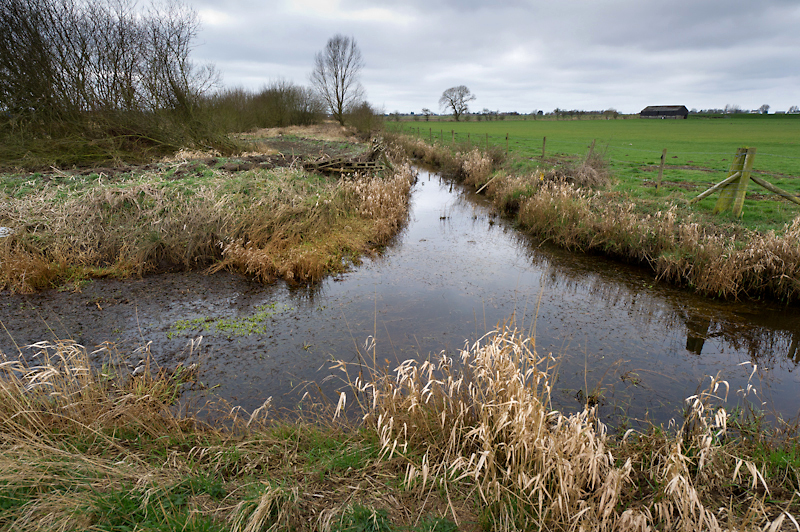
The apparent lack of anything in the local landscape has always frustrated me when walking with a camera. Yet the ditches and drains which abound are what make the land what it is. Martin Mere (not the WWT reserve which has appropriated the name) was at one time the largest lake in England. The flood plain of the local river would no doubt be largely marsh for most of the year.

I have photographed these watercourses in the past, but it was only recently when I sat down to consider where my photographs are heading that I realised that the constant need to drain the land around me could be something worth paying more considered attention. The same could be said of the contrary need for irrigation of the crops which grow on this land. There is an irony in seeing irrigation reservoirs built alongside drainage ditches, of watching farm-workers clearing field drains in winter and watering crops in the same fields come summer. It hadn't been my intention to progress this idea yesterday, but it worked out that way.

In my film days landscape always baffled me. For some reason digital makes it easier for me to see pictures in the landscape. Perhaps it's the ability to review things instantly, or perhaps the fact that trying shots out doesn't cost anything, so I am getting more practice. Probably a combination of the two.

On first review I preferred the black and white conversion of the picture below. The more I look the more it is starting to look somewhat over-dramatic.


The blogging software reduces the quality of photographs when it resizes them. They should look a little better when clicked on.

Saturday, 10 March 2012

Gates

No doubt Freud (Sigmund, not Clement) would have had a field (awful pun) day with my interest in taking photographs of gates. They are something I have always felt drawn to as subjects. Here are two recent ones.  Both converted to black and white for some reason, just like an earlier one in this gallery.


Tuesday, 6 March 2012

The Bay Leaf

Another brief wander round my village this afternoon.

The date over the original door was 1640 and the name of the pub The Ram's Head. Times move on and the building was extended and modernised to become a restaurant. It never lasted long under any management and has been boarded up for some time now. Black and white seemed to make sense when I looked at the pictures on the computer owing to the dull light and the subject matter. More here.


On a cheerier note a picture, from when the sun came out again, of the old warehouse between the river and canal - cornily framed by the canal bridge..


Sunday, 4 March 2012

Windy

With the wind blowing and the sun shining I headed to the beach. When I got there the wind was more than blowing, it was almost gale force. Dry sand lashed across the shore and the kiteboarders were leaving the water one by one. The wind was so strong I struggled to hold the camera still enough to get sharp shots at over 1/2000th of a second. I gave up trying for any action shots as the few remaining 'boarders were out of range. So I made do with scenics and suchlike. Even that wasn't easy in the wind, and all the while trying to prevent the filter on the lens getting sandblasted.

I tried to get a picture that showed the blowing sand, a kiteboarder on the 'horizon' and a kite in the background all framed in a satisfying arrangement - and failed. The shot below came closest. It's a slight crop and not razor sharp thanks to the gale. The idea was there though.


Back at the car I swapped to my cheap'n'cheerful 28-105 and came away pleasantly surprised at the quality of the files it produces. Sharp enough and contrasty. Best of all it's lightweight and compact. However, it's not a snappy focuser and it lacks the instant auto-focus override I find myself using a lot these days. A very useable lens nonetheless. I might seek out a wider c'n'c zoom to complement it. My reasoning is that I like to travel as light as I can, so a c'n'c lens in a pocket or small non-camerabag-bag, provides an alternative to the lens I'm planning on using most if another opportunity arises or things change as they did today.

The picture below is another almost shot. The light is great, the composition is okay but the 'action' doesn't add much. Given the lack of a lens hood, and the UV filter, which are both supposed to create ubearable flare, the lens seems to have managed alright. Sure I did a fair bit of work with the fill slider and other adjustments, but it made for an acceptable (to me) picture. Full set of pictures here.


What is and isn't acceptable is entirely subjective. I've been looking at black and white photos from the 35mm film era recently in my collection of photo books. I'm sure digital has made us all too critical of what is acceptable and what is not. There are loads of classic photographs which when enlarged beyond postcard size reveal huge grain, and many of them are actually either blurred (through the film forcing a slow shutter speed) or simply not quite focused.

Makes you wonder if all that is needed for 99% of photographic applications really is a compact camera. Let's face it, it's easier to get sharp shots with little 'grain' in low light from the X10 than it ever was with my Pentax and Ilford HP5. Good as it is, and much as I like using it, I prefer the general handling (and the viewfinder) of an SLR. If only they could be made smaller. Have I mentioned that before?

Thursday, 1 March 2012

Be yourself

I'm no landscape photographer by any means. I think I'm making some progress with picturing the countryside recently. In the past I was trying to make pictures like ones I'd seen and failing, instead of trying to make pictures of what I was seeing myself.

I find a lot of landscape photography tends towards idealised romanticisation of the world. There always seems to be an emphasis on the dramatic (as in theatrically overplayed). Typical subjects being mountains, ruins, and sweeping coastlines - lit by thegolden light of dawn or dusk, or featuring lowering cloudscapes. Even those that don't go for dramatic overkill are shot on sunny days with bright blue skies. But most of the world, most of the time isn't like that

I find I'm making a lot of symmetrical images, a lot with very low or high horizons and a good few with the horizon dead central or nearly so. There is a conscious effort to avoid using the deathly 'rule of thirds' when it comes to placing the horizon. Apart from it being a cop out, there are other ways to balance pictures.

Something else I am realising is a feature of my landscapes is the hand of man. All three of the pictures here illustrate that. They are from a walk this afternoon selected as examples of slight progress rather than fully realised picturing. The first and last are of ditches, the second includes two wind turbines and there are pylons in the first.

What I am realising about making pictures of the land is that it has to be a slow process. The precise viewpoint has to be found, and the right light waited for, or returned for at a later date. This is not in my usual way of operating. It's a discipline I think will benefit me in the long run. I made on picture the other day which has a composition I like, but the light is wrong. I shall return to try and improve on it. However, it is a picture of a mirror calm tidal river. To get the look I want will require the high tide, the right light, the right sky, and no wind. Of course there could be a better picture to be taken from the same spot under other conditions. I'll only find that out by trying.