Sunday, 19 April 2015

The gift that keeps on giving

Not having been to the sandplant for a few weeks but having driven past it I thought an evening visit might be in order. What a difference low evening light and blue skies makes! I like dull overcast days well enough, but raking light brings out texture far better, which can be important for some pictures. Bright sunshine also makes colours more vibrant. Something that no amount of computer trickery can manage if the light was dull in the first place. Different light gives different ambience to pictures, as does it's direction. All of which makes me thing about different pictures from the same subject, and given the changing nature of the sandplant there are always new photographs to be made.

This picture wouldn't have worked had the sky been overcast and the light flat as it's all about the colour and the cloud seemingly hanging over the skip.


The annoyance with this picture is that the top of the skip is in line with the horizon. Unavoidable really as I wanted to include the rust metal in the shot. If I had been lower in order to push the top of the skip above the horizon less of the tangle of metal would have been visible. Any higher and ther ould have been too much space between the skip and the cloud.

It's a funny thing, but I find if I am using a zoom lens it usually gets used at the two extremes. rather defeating the purpose of the thing! At least when using two zooms that gives me four focal length choices. A good enough reason to have lenses that don't do what most amateurs want them to do - cover a continuous range of focal lengths. I know it's often mentioned that single focal length lenses make you think about your pictures and that zooms make you lazy. It's often said because it's true. When you have to use your feet to frame shots you tend not to just walk forwards or backwards, you also move left and right, and even up and down to get the framing you want.

While the first picture was shot very wide with the sun to my side, the next one was shot long and into the light. There's compression and shallow depth of field to provide isolation, and the quality of light adds a different feel. Most photographers would have preferred a gorgeous blonde as their subject rather than the bucket off a digger. But that's so clichéd!


The place has changed dramatically. The outer bunds are disappearing fast, but the rabbits are clinging on. The interior space is getting flattened and the concrete is almost all broken down now. This time next year it will be unrecognisable to what it was twelve months ago. The next picture is a very boring one, but to me it has a symbolic significance. The grass on the right is original saltmarsh, the track-marked sand to the left is reworked land. If all goes to the plan I have heard I expect it will eventually all look the same. I expect that there will remain traces of what went before under the returned saltmarsh as I cannot see every scrap of rubber, plastic or iron being removed from the site.


As ever after a trip to the sandplant there's a gallery/slideshow of today's pictures to be found here.

Sunday, 5 April 2015

Project thoughts

I suppose I could pretend that one inspiration behind this project is Hokusai's 36 views of Mount Fuji - but it isn't. It's just a daft idea that grew out of finding the local church hiding in a few of my pictures, then thinking that I could make a series as a pastiche of the kind of sets of postcards or calendars that institutions like churches sell to raise funds. Badly produced calendars with hideous graphics. I've already made the front page of the calendar with a tasteful mix of colours.


That gives a clue to the way my mind is working! I already have a few suitable pictures filed away. Some are a bit too pretty to fit the skit really well, almost too much like the kind of thing that really would be used in such a production!. But I took one yesterday that I think might work.


This project does stand a chance of getting completed. For a start I don't have to go very far to take the pictures. I can take them pretty much any time I have an hour or less spare. Best of all I have a target to aim at (twelve pictures), and a clear vision of what sort of pictures are required (ones where the church isn't the obvious point of the picture). It's also quite light-hearted - although on the serious side is the fact that with it being so flat around here the church spire really is visible from unexpected, and distant, viewpoints.

This is in complete contrast to a project which I have been making notes and plans for which I am pretty sure will never get any further than that. It seems like a really good idea that might even  appeal to people. Trouble is I not only know what kind of pictures I would need to make, I know exactly where to make them and even how to frame some of them. To actually go and take the pictures would be just joining the dots. Yet some people seem to like working that way.

I'm wondering if there are two photographic personalities: the proactive and the reactive. The former would approach the church project by using Google to check out potential vantage points, plan out what time of day would be best in relation to the position of the sun, decide in advance what focal length was required. Me? I pick a lens at random and go out the door for a walk when I feel like it. The only planning is to try to remember to keep looking for the spire and not get distracted by other things.

Doesn't often work though. I mean, this picture was all about evening sunlight, space and the shapes of the trees. Part of my ongoing collection of views around the village. But look! The church is in the frame. So which folder does this file go in?


Sunday, 22 March 2015

Ayers Rock

As usual when lacking motivation (which is not the same as inspiration) I headed for the sandplant on Saturday to see how things had changed. It's funny how my little brain works, but this particular mound of reclaimed sand reminded me of Ayers Rock. Probably a tenuous connection for anyone else! Irrespective of that I like the way it's difficult to gauge the scale of the view.


This made a break from the easy attraction of the frogs in my pond. They were still at it, although fewer in number and less approachable. I think they must feel safer when there are dozens of them together. I thought I'd play around with DSLRs and close-up 'filters'. Once more I shot some video and the screw in close-up lenses worked well for that. Not quite so hot for hand-held stills. Sharpness isn't quite so critical with moving images.

There is a noticeable difference in 'look' between the pictures made with my compact camera and DSLRs - the difference between the crop and full frame shots is much less easy to spot.


The fishing DSLR has been getting quite a bit of use recently. It's handy for taking product shots for my website and fishing blog because the kit lens focuses close enough for me not to need a macro lens, and the 24 mega pickles mean it's easy to crop in for web use. The sensor seems to my eyes to be every bit as good at low ISOs as those in my larger sensor cameras. Even better in terms of dynamic range than the older one. If I was a landscape specialist I'd be more than happy to use the camera all the time because the speed of handling and focussing isn't a problem there. For wildlife the extra 'reach' the smaller sensor gives is quite handy. That's why I used the camera for photographing and videoing the frogs - although the compact does as good a job and is easier to use in some respects. All this has got me thinking if I really need the big sensors.

Today I was back at the sandplant with a wide zoom on an FX body and a standard zoom on a DX. Although the standard effectively becomes a medium telephoto, which was why I took that route. I keep thinking that one body of each format would enable me to cut down on lenses while covering the same effective focal lengths.

Nice in theory, but in practice there's the unavoidable fact that no matter how good smaller sensors are in decent light at low ISOs they can't match the bigger sensors when it gets darker. As I like to shoot hand-held in dimly lit buildings (tackle shop, poultry shed) that is a big deal. I don't like dwelling on photographic gear and would rather think about the photographic process. The only reason I'm pondering out loud is that I'm trying to pare my gear down to a logical minimum, primarily in terms of bulk.

Standard becomes medium
Quite why I wasn't 'feeling it' this weekend I'm not sure. So it was a surprise to find a couple of pictures from the sandplant that I thought worked reasonably well. Perhaps sometimes when you are in an uninspired mood and just snapping away something in the subconscious takes over?

This first one shows the high tide covering land which is a recent breach in the bund. I'm told the plan is for at least part of the workings to be returned to salt marsh, and this illustrates the start of that process.


The second picture does nothing more than show piles of reclaimed sand. I like the backlighting, the perspective, the curve of the tracks and the reflected clouds in the puddle.


The thirds shot was grabbed as two birdwatchers made their way back to their car. Their presence gives a sense of scale - although the wide angle exaggerates distance - and the machine adds a splash of colour to liven the image up.


Despite being in an unenthusiastic mood a few pictures have been added to the sandplant collection. This buoyed me up and I headed out the door after an early tea to see what could be done with the last of the daylight. Hand-holding for landscapes at sunset is not the recommended procedure. But it's the way I do it. I tried to capture the feeling of a still spring evening by shooting into the sun. Then again, I don't make the usual landscape pictures. I doubt many photographers would have a container as the focal point in a sunset picture...


Tangles of undergrowth and branches always attract my eye, and when lit by a low sun they can make for interesting patterns. I'm not sure that this sort of picture would work if everything was in focus from front to back. Although visual confusion is part of the point of this pictures there has to be some signifier of depth, and blur is one of them.


Monday, 16 March 2015

Accepted wisdom

I almost had my faith restored in 'that forum' the other week after I posted a thread about one of my projects and the level of discussion (briefly) rose above the 'UV filters degrade IQ' level. Ho hum. All has returned to normal with the usual ultra wide for landscape, super-tele for wildlife, nothing shorter than 50mm for portraits cobblers. I suppose it depends how you define a portrait for that last one. If only I'd had my ultra wide on I might have got both of Groundskeeper Dave's feet in the frame...


What I did manage was a picture that I quite like as an effort at summing up the first preparations for the forthcoming cricket season. There's a lot of green though, which Hockney says photography doesn't do well.


I mention Hockney because I've just this minute finished watching a biography of him on iPlayer. Well worth a watch - although I am biased as a bit of a fan. I knew he'd used and played around with photography, but not how early on he'd started. Given that he can be quite disparaging about what photography can achieve compared to painting he must have a love/hate relationship with the medium. I entirely get where he's coming from, and there are frustrations with photography that sometimes make me want to pick up a pencil or brush. Yet those very limitations are what makes the medium interesting, and challenging.

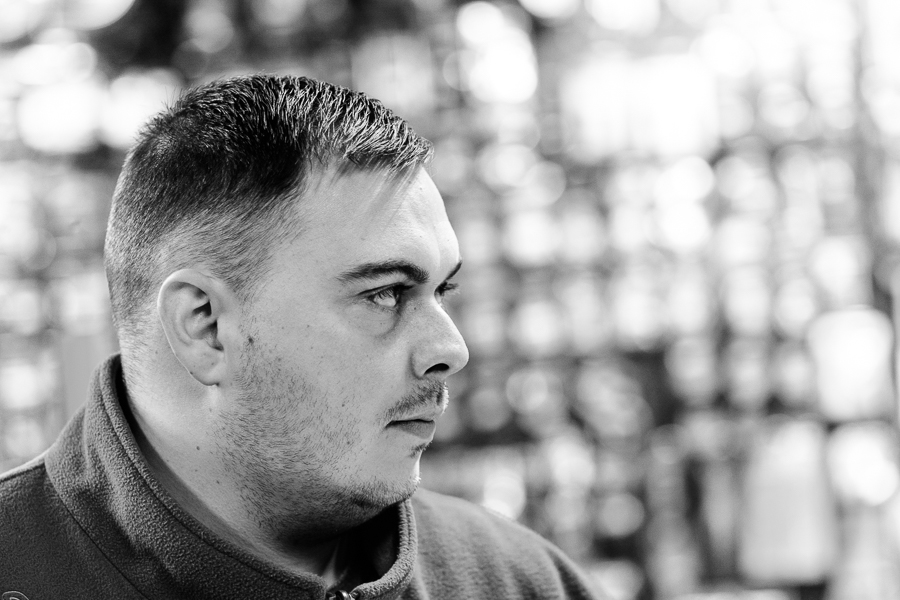
A particular limitation is in portraiture. I'm still not convinced that photography can make good portraits. Not straight photography at any rate. Which is why, leaving aside Martin Parr's dictum that a smiling face ensures a snap, I'm never sure where the line is drawn between snapshot and portrait. Does a portrait have to be premeditated? Or can it be grabbed like the picture above? And does colour reduces the chances of success? Black and white certainly adds an aura of seriousness. Maybe I'll post some people pictures on a forum and ask for advice. If only I could get them sharp...


Tuesday, 10 March 2015

Buses and books

I try to follow Niall McDiarmid's blog on Tumblr but I often miss a few days. Luckily I spotted the announcement that a second book was imminent so I've been checking to make sure I didn't miss out. Having placed my order it's safe for me to let my reader(s) know that Via Vauxhall is now available to pre-order!

Having enjoyed Niall's previous book, and having seen a number of photographs from this project, I'm looking forward to receiving my copy.

It seems like there's a bit of a thing in the UK for bus centred photography. Tom Wood's All Zones Off Peak is out of my price range, but George Georgiou's recent Last Stop is tempting. Maybe the subject appeals to me because I spent a lot of time on buses as a student and took photographs of my own in bus stations and even on buses?

Bus stations are places where people gather with a common purpose of travelling, but are often preoccupied and oblivious to everyone else. There's also something about the functionality of bus stations that suits photography - not least the now listed Preston bus station which I am far from alone in having photographed. The three photos below were made circa 1979/80 in the now 'redeveloped' bus station in Southport. I wish I'd made more of them, but at the time the place was somewhere that would always be there. Just like everywhere. We assume nothing will change, although it inevitably will. Reason enough for recording any of the everyday places we visit.