Tuesday, 6 July 2010

Bad timing and a tip-off

With rain forecast for late on I popped out on an errand at lunchtime, taking a camera with me and intending to catch some damsel or dragonflies while the sun was out. By the time I got to the litter pit the sun had changed its mind. There were a few damsels around the small ponds, and quite a few small skippers but I didn't get much that was any good. The male blue-tailed clinging to a horsetail was about the best. The emperor was in evidence, as was the one on the Litter Pit itself.

One that looked sharp on the LCD

While walking round to the bay where the emperor flies I heard a racket in the willows at the back of the path. It turned out to be two juvenile wrens, which perched close enough for long enough for me to get a clear shot of one. Even though the ISO was high with them being in the shade on a dull day they turned out not too bad.

ISO2200 with Neat Image noise reduction

The emperor was chasing around and proving impossible to photograph. The wind wasn't strong enough to force him to fly in a straight line and he was all over the place. He was also duelling with the mystery dragonfly, which I thought was a brown hawker. As chance would have it this was confirmed by a chap carrying out a dragonfly survey for the landowner. Chatting to him was enlightening, and he told me of two small ponds that are out of the way and worth a look.

A few minutes after we went our separate ways there were spots of rain on the surface of the pit. I beat a hasty retreat to the car. As I got in the rain eased off so I went to look for the new ponds - apparently dug for the benefit of great crested newts. They took a bit of finding, but they will be worth another visit on a sunny day. Not just for the insects but the birdlife too. I'll be able to sit a while and wait, hopefully undisturbed by other humans. While I was wandering around I saw a few damsels and watched another brown hawker chasing commas. There were quite a few other butterflies around too, not to mention bees and various flies. A nice secluded spot alright.


Monday, 5 July 2010

Out with the big lens again

My 150-500 came back from Sigma this morning, so I was keen to get out and give it a whirl but short of ideas where to go. In the weeks it had been away things had changed. Birds had fledged and leaves filled out and darkened. Still lacking a decent photo of a reed bunting I thought I'd go look for one where I had seen some close to a path through a weedy field when hunting damsels. I chose to approach the field from the opposite direction as the path was less overgrown. I got out of the car after pulling off the tarmac, put my over trousers on in case I wanted to push through thistles or sit on the ground, got my camera and locked the car door. My right foot slid in that way a foot slides when it steps on dog leavings.

I scraped the worst off my boot in the grass and set off. Walking alongside a ditch I was stopped in my tracks by a red-legged partridge giving me the eye from the edge of the path. Normally red-leggeds slink away when you approach but this one froze and stared at me. I managed three shots, and was thinking of trying a different angle when the bird came to its senses and flew off.


The reed buntings were around, perching high on tall stems but too far off. I decided to carry on past the area where they were and try photographing them on my way back. When I reached the damselfly ditch I was surprised to see it totally covered in duckweed and just one damsel to be seen. Maybe it was a little late in the day for the damsels, or maybe the duckweed had moved them on, it possibly being impenetrable for their egg laying efforts.

Over the ditch and the skylarks were around still. I spooked a few without managing any photos, so I retraced my steps. Again the reed buntings were singing, not that it's much of a song, and perching in good view - too far away. I was in two minds as to staying and hoping for a shot or two or going to the pull-in where I'd seen a reed bunting and other birds on Saturday. I quite fancied sitting in the car with the camera to get out of the wind.

On arrival there was nothing in the bushes, but swallows were twittering and flying around in numbers. I tried for some flight shots without success but I noticed a young one being fed on the wing. I was just about to set off up the road when A swallow came down, amidst much twittering, and I saw it feed a young bird perched on a fence some twenty feet in front of my car. I hadn't noticed the perched swallow when I pulled up because of some rape that was obscuring it. This also made it tricky to get a clear shot at the bird, but I made a few attempts, and as I did so another juvenile landed on the fence. By walking round to the right I could get a clearer view of the birds, although I was slightly further away.

It wasn't long before an adult came in with a beakful of insects and the two young birds started calling and gaping their beaks wide. I spent an fascinating hour and a half watching the swallows coming and going and taking photos of the activity. There was another juvenile that landed but didn't stick around for some reason. And at one point there were six birds perched on the fence, three adults which seemed to be sleeping. Maybe they felt safer sleeping where there were other birds coming and going and the young ones keeping an eye out for their parents.

Huddled together against the wind


One of many feeding shots

As the light level started to drop I left the swallows to it and went to look for a barn owl by the river. As soon as I got out of the car I could see it in the distance working over the field I hoped to see it in. However it was a fair way off, I had arrived a few minutes too late. It was working away from me too. I watched it for some time hoping it might come towards me, but knowing it wouldn't. Too soon the light was too poor to make any worthwhile photos so I grudgingly headed home.

For more of the swallows check out Flickr.

Saturday, 3 July 2010

Lazy summer stroll

After listening to England crumble under the Aussie attack I went for a look round a local nature reserve that never has much to look at. It was no surprise to see very little, and few photo ops under the full summer canopy. Having taken a tour of half the reserve I got back in the car and drove a mile or less down a country lane, parking up in a bit of hard standing at the side of a hardcore track. As soon as I got out of the car I saw a corn bunting singing from the top of a hawthorn a few yards away.

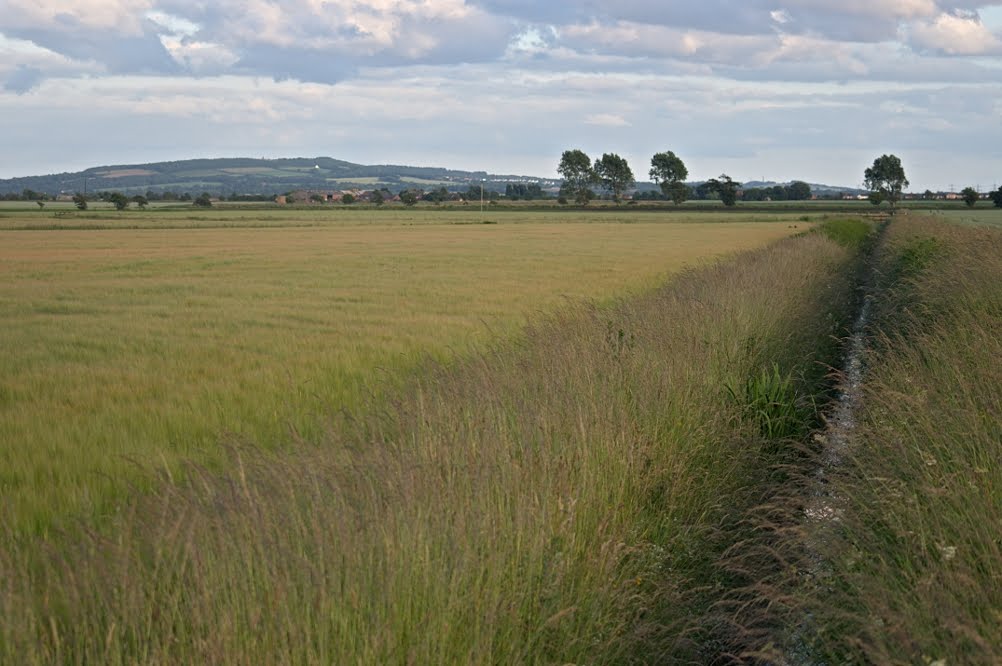
There were plenty of other birds around; goldfinch, reed bunting, whitethroat  being seen and others heard. Swallows were swooping low over the wheat fields in the still air. I ambled along the lane and off across a public footpath toward a small drain. There was hardly a sign of human activity, just a tractor spraying a crop a few fields away. The light was soft and warm and despite only having the 70-300 with me I took some pleasing, if not superb, landscape pics. One good thing about telephotos for landscape photography is the way they compress distance, making shapes more graphic on the picture plane. Wide angles get too much detail in, which when viewed small becomes visually meaningless. Telephotos give things more impact. Well, that's my thinking.


After retracing my steps to the car I carried on my journey, heading for a field where I had watched wheatear, yellow wagtail and skylarks earlier in the spring. It was a pleasant change to park up and walk the track in t-shirt rather than sweatshirt, fleece, woolly hat and mittens! The migrants had long departed, but the larks were still to be heard and occasionally seen, along with oystercatchers passing over head.

I was scanning the wheat for lark activity, I'd seen one perch briefly on an ear of teh crop, when I saw a dark shape that I thought might have been a male reed bunting's head in amongst the wheat close to the track. I approached it slowly and as quietly as I could, realising almost too late that what I could see was the dark tips of a hare's ears. Definitely the closest I've ever got to a hare. I managed to fire off a couple of frames of the ear tips before the animal spooked. I say 'spooked' but it just loped off slowly betraying it's presence only by the swaying of the wheat until it broke cover and was away, still not at top speed. 


That was my lot, the light was going and I'd run out of ideas for places to visit. Time for home and  a cuppa.

Friday, 2 July 2010

Back again

I spent most of the morning helping a mate who is quite new to photography set up his camera to photograph birds and other wildlife. I also seem to have become his personal shopper as I'm ordering some stuff for him off the interweb - him being even more scare of computers than he is of camera manuals!

When the sun came out to stay just be fore he left I thought I'd head back to the Litter Pit, which I found deserted, save for the wildlife. There were not so many dragonflies in evidence at first, but I did find a lone emperor in the bay where the UFD (unidentified flying dragonfly!) was seen yesterday.  It even came close and hovered, but always behind one of the reed leaves at the edge of the small gap I was shooting through. I must have tried over 100 times to get a decent image, and only one was passable with a heavy crop and more sharpening than usual.


At one point I thought an even bigger dragonfly had come into the viewfinder, but it was a kingfisher streaking past. The first I've seen there, and another bird to add to the growing list spotted at the site.

At the little pools there were plenty of damsels, many paired and  mating, a handful of four-spotted chasers and another emperor patrolling the bigger pond. A couple of times I was distracted by shimmering wings bigger than a damsel's but smaller than a chaser's and tracked down a couple of common darters perching low in the stalks by the water's edge.


There were quite a few butterflies in evidence - meadow brown, common blue, skippers, and speckled woods in the trees. These insects really are difficult to stalk, flying off on their erratic paths never quite settling where you think they will, and always low down and obscured when they do making them very tricky to photograph successfully.

And so passed a peaceful couple of hours on a sunny afternoon. If only the place was always undisturbed like this.

Thursday, 1 July 2010

Back to the litter pit

In many ways it's depressing visiting this pit, it's out of the way, well naturalised, but neglected. It also holds carp so anglers visit it. I won't tar them all with the same brush, the ones I have spoken to despise the duck-shooting, fire-lighting litter-louts too. There is a faction that insists on leaving cans, bottles, bags and more behind. It's such a shame as the place is everything a nature reserve would be if I had my way - unmanaged with no hard paths, just tracks that people have beaten out over time that follow the contours of the land and are overgrown in places.

As soon as I arrived there were chasers and emperors to be seen, then damsels. Reed warblers were being as noisy as reed warblers can. I walked through a clump of birches that had obviously been planted by the landowner, whoever that is, to find a burnt mess of a bed that looked as if it had been used as a barbecue. Yet feet away there were dragonflies and warblers.


Round the corner in a bay choked with Canadian pondweed carp were basking and chasers chasing over the surface. A large dragonfly came and checked me out, but I couldn't get a shot of it nor a positive ID. On the other side of the bay rudd were swirling in gaps in the weed. Then the sun went in and the dragonflies disappeared.


Bordering the pit, beyond the dense reedbeds, is a wild meadow filled with vetch, trefoil and other colourful plants. This harbours butterflies and moths in abundance. Skippers were spotted and burnet moths. And by the edge of a small pit, not much more than a scrape in the ground but one that holds fish, a common blue was briefly seen. Just for long enough to get a ropey photo with the wrong settings before I put the flash on the camera. I didn't see it again... The blue was perched on a mares-tail, which is prolific round the small pit and the two ponds which are mere wet depressions that are drying out in the current heatwave.


On the other side of the big pit is another, smaller, one which is rapidly losing the open water as reeds encroach from the margins. In the land around this pit I managed to photograph a burnet moth and a small skipper. One of these days I'll have to spend more time at this place, not least to see if I can get some good shots of the many reed buntings that inhabit the area. If only it wasn't quite so accessible and litter-strewn it would be truly idyllic. Of course, if it was well managed and the lowlife excluded from it I'm sure it would end up becoming manicured like so many 'proper' nature reserves. Sometimes you can't win.