Showing posts with label damselflies. Show all posts

Monday, 15 July 2013

Non-macro

The place I'm fishing at the moment is alive with damselflies. Nothing unusual, only the three common blue species, but I've never seen them in such numbers. Not even when I've visited a dragonfly breeding pond. Come evening as the air cools down they become approachable. As teh fish weren't biting I thought I'd see what I could do with just the non-macro 50mm lens I had on the camera.

Filling the frame with a damselfly wasn't an option, so placing it within the frame, stressing the habitat and trying to make interesting pictures was the order of the day. As always with this sort of subject using trap focus (the shutter firing only when focus is achieved on the subject) came in handy. This really should be a standard feature on all cameras, but doesn't appear to be. I set the focus point where I want it in the frame and the focus distance as short as it would go, half pressed the shutter release then moved the camera in until the shot was taken when the insect was in focus. Dead simple.

The aesthetic considerations were mainly about how much depth of field to use and balancing the flash and ambient light. Too small an aperture and the background can go dark and/or show too much detail. The benefit of a digital review is immense in these situations. The two shots below demonstrate how opening up the aperture helped make the damselfly more prominent.


Trying to take photographs while letting the rods fish for themselves never leads to great pictures. My little grey cells dis start working as I considered ways to make pictures of damselflies which were different to the usual close ups which make people exclaim at how much detail there is in the photograph. Of the few pictures I made the one below works best. There is nothing for the flash to cast shadows on behind the subject, so making the picture look more naturally lit. Not perfect (that pale stem behind the damselfly is annoying)  but it might inspire me to go and have another try - without the fishing tackle!


Saturday, 11 September 2010

Still a few about

Unexpectedly the sun shone. I'd promised myself another trip to the moorland quarry in the hope of finding some inert hawkers. Climbing the hill I saw that one of the cows was not as other cows. I retraced my steps and clambered over the fence into the next field. Although the bull looked placid enough and was in with plenty of cows I wasn't in the mood to find out.


As soon as I approached the first pond I saw hawkers and copulating black darters on the wing, and a few emerald damsels in the rushes. They were all rather difficult to pin down. I tried a few fungus shots but really needed a tripod and gave up. Wandering around I tried some spider shots that I was too idle to put the flash on for. While I was doing this I hard a rustle of dragonfly wings and expected it to be a common hawker nearby, so the light insect that settled on my right hand I assumed to be afly of some sort. When I looked it turned out to be a male black darter, and it wasn't for moving either!

As usual I disturbed hawkers, commons in the marginal rushes and the surrounding heather. When I saw one settle it would fly off before I got close enough for a shot. It was quite sad to see a pair of black darters wasting their time laying eggs in a puddle on the path. That's nature for you though.

Hearing a whirring in the margins I crept as stealthily as I could towards it. A common hawker flew away but three emerald damsels remained. One male clasping another that was clasping a female in a wheel. I saw this earlier in the year with banded demoiselles.


At the smaller pond there were plenty of black darters in the air, some paired up, and some paired hawkers that I couldn't get an ID on. With the sun shining brightly it was warm enough to strip down to the t-shirt. As soon as the sun went in it was cool enough to require the replacing of the fleece. Then it rained. Heavily. I took shelter in the wood where I took a lazy pohoto of a fungus of some sort. Lazy because I used the in-camera flash. It turned out quite reasonable considering.


It was a passing shower and I was back out again. It continued to prove difficult to get any decent dragonfly photos. A pair of hawkers settle on a vertical rock face, but my stalking skills let me down. I tried some less flighty subjects. Lichen are really fascinatingly shaped creations when you look closely. Static they may be, but they're still tricky to photogtraph. Practice is required, and probably a tripod.

There were a fair few grashoppers around, and they were quite approachable. Not always hopping off when I prodded them. I assume the rain had cooled them down a bit. They can be kind of cute! More time should have been spent with them in retrospect.


Another shower passed over as I was taking a walk away from the quarry. Only a light and brief one. Then it came warmer than ever. A final look around the ponds revealed nothing that I managed to capture with the camera. A couple of hawkers, possibly migrants, patrolled the large pond  and clashed, wheeling away together noisily over the heather clad slops around the pool.

Rather than brave the bull I took the longer route down the hill, then had a wander round the overflow from the reservoir, and along it's banks. By the time that was done I was about beat - and hungry. Interesting though, as I think I found a spot roe deer might frequent. It's close to a place I stumbled across a small herd in the pre-dawn darkness when fishing one time. It's a fly infested bog though!

Tuesday, 27 July 2010

A sunny evening

I wasn't sure where to go looking for stuff, or what to look for, this evening. In the end I hedged my bets and took big and not so big lenses out, which is unusual for me. At the last minute I turned off the main road and down a dusty track to check out a patch of waste ground between the track and two ditches that I thought might hold some interesting insects. With the sun being so bright I left the flash gun in the car. There were a few butterflies around, one of which was visited by a fly while I was attempting to take it's portrait. Hence the soft image.

Gerroff!

Other butterflies around were the usual meadow browns, plus a few red admirals and a peacock or two. I was hoping to see some damselflies or dragonflies, and I did disturb one that I didn't get a good look at. It was quite a dark one and not too big. Possibly a common darter. As I drove back along the track I saw another dragonfly heading up into the willows along the bordering ditch. Those were the only two dragonflies I saw. Maybe the next port of call would be better? I was off to see the barn owl, and with it still being bright I thought there might be some dragonflies near the ditches.

After parking up I set off to the first footbridge. When I crossed it I saw the paths had been mown, revealing the public right of way to the left which I had not taken before. This runs alongside a ditch that had buckler fern lining both banks. I think it's buckler fern, at any rate. As I walked along I could hear corn and reed buntings, but no sign of any until a corn bunting flew out of the fern just a couple of feet in front of me! I slowed my pace and disturbed another bird. Paying more attention I could see there was a group of young reed buntings in the fern on the opposite bank, accompanied by at least one adult male. Then I noticed two young corn buntings on my side of the ditch. I went into stalking mode and slowed up even more. The corn buntings didn't let me get very close, the reed buntings seemed to get used to me, and I got very close indeed.

Corn buntings

An unconcerned young reed bunting

I spent over a quarter of an hour photographing the reed buntings before turning back to go sit on the second bridge and await the owl. It was still very sunny and I thought the owl may appear later than usual. By eight there was no sign of it. Clouds had covered the sun and the air was turning slightly cooler. I went back to the car. Leaning on the gate I kept a vigil for a distant glimpse of pale wing movement. There was none. I went for a wander along the lane hoping the owl would be in the field behind the beeches. When I chanced to look along the lane I was surprised to see the owl working up the verges of the lane towards me.


Hovering in anticipation

As there was no cover for me I headed back to the gate, looking around to check on the owl from time to time. I saw it hedge-hop into the field. As I neared the gate I practised squeaking. I did too good a job. Looking back again the owl came over the bank onto the lane and was heading straight for me. I dropped to my knees and tried to blend into the grass, but too late. I got two dodgy pics as the owl saw me and turned tail.

Sussed!

I hoped, in vain, that the bird would work the field behind the beeches and appear in front of the gate. What it must have done was head out across the field. When I saw it again it was far off in the distance, closer to the main road. That was where it stayed too. I could see it working along a hedgerow a few yards from passing traffic. In the end this was too much for me. Knowing the futility of it, and with the light very poor, I drove round to the main road and pulled up in a gateway that looked back towards my initial parking place.

Now the cloud had rolled away and the low sun was throwing golden light on the landscape. All I needed was a barb owl to fly into a shaft of sunlight within range of my camera. When the owl showed up it was half way back to the spot I'd recently left... It was soon gone, too. I knew I'd blown it with my premature squeaking efforts, so I couldn't complain. The buntings had made the outing worthwhile.

After crossing the moss close to home a bird flew from the hedgerow on the right of the road and landed on the verge on the left. As I got closer I was expecting a thrush or blackbird to fly away as the car approached. To my amazement the bird that took to the air was owl shaped. A little owl. And closer to home than the one I had seen previously, making me wonder how many of them there are in the locality. The more you go around with your eyes open, the more you see.

PS - these aren't the best photos, but the more interesting ones.

Sunday, 25 July 2010

Another dragon afternoon

Even though it's Sunday I went to the dragonfly pond. There was a woman and her dog already there taking photographs (that is to say the woman had a camera), but the dragonflies weren't flying. It was cooler than of late and dull, so it was a case of stalking them. There were a few damsels around, but I managed to put up a couple of common darters, one of which landed in view and I was able to creep up on it and get close enough to use the Raynox without spooking it. It was so unconcerned that I got bored before it flew off. In fact it didn't fly off until after the dog owner had managed to get some shots of it after I pointed it out to her.


After more wandering round I disturbed another darter. This one looked to be recently emerged, and one wing was either not going to fully unfurl or was still unfurling. As a result it was even more immobile than the first one, and I got even closer with the Raynox.


I went for a stroll through some unkempt grass and mixed herbage where I found a bee feasting on a thistle. I spent quite some time photographing the bee trying to get the perfect composition with the bee in just the right place on the flower. Only when I revied the photos at home did I realise, that like the darter macro, I'd left the ISO on auto instead of setting it manually and it was higher than it should have been. Oh, well...


Time was getting on and hunger was gnawing. I still called in at the litter pit, after a wander along a path by a nearby wood, and then into the wood where I got low down for a first attempt at fungi photography. The angled eyepiece is ideal for this. Given that fungi don't run or fly away I guess it's time to get the tripod out and slow the shutter down for future efforts. It's a start, but I should have done more 'gardening' to tidy the picture up.


At the litter pit craters there were as few dragonflies in evidence as at the dragonfly pond. The usual blue damsels and a couple of common darters were all I saw before the clouds darkened, rain threatened and the stomach rumbled.

Friday, 23 July 2010

Dragon afternoon

Summer returned. Leaving stuff to dry I went in search of odonates. My first task was to try and get a closer look at the darter I'd seen at the litter pit craters. This time I took my wellies so I could paddle among the horsetails. Although the crater is tiny there were small carp crusing between the stems that almost fill it. Horsetails are ancient plants, and dragonflies are ancient insects. The two go well together. Almost straight away a femal common darter flew up, then I saw a male. It took a while, but patience paid off and one of the two I saw took to landing on some drying ground. It would return to the same place and I managed to get as close as the lens would allow.

Common darter

There were plenty of damsels around. Blue-tailed ones for the most part. I wasn't going to photograph any until I saw one that looked to be covered in something nasty. At first I thought it was dead and stuck to the stem, but it flew off a foot or two.

Blue-tailed damsel in a bad way

Also in evidence were a a brown hawker (which I managed to sneak up on when it was perching and got an almost okay shot of it) couple of male emperors. One was patrolling the bigger pond, the other was over the largest crater. This confined body of water allowed me to get close to the insect, and limited it's flight opportunities. If I had stuck around longer I might have improved on the flight shot below.


Male emperor

Would there be anything at the newt ponds? At first it seemed very quiet apart from butterflies. Gatekeepers and a few skippers were about, plus some whites. Damsels were hard to find, a single emerald being the highlight at the larger pond. Passing the hidden pond on my way to the smallest one I was surprised to see a shoal of rudd cruising about at the surface. I'd assumed the pond to be silted and fishless, but it looked much clearer than before and those definitely were fish!

Unexpected rudd

The small pond was also lacking damsels, although there was an emerald in the usual spot. A brown hawker flew over the hawthorns, as one had done on my last visit, and when I returned to the larger pond (having noted deer tracks on the way) I spent a few minutes watching hawker working the pond and surrounding trees and grassland.

Time was getting on. A call at the dragonfly pond was in order. There's a £1 parking fee there. I checked my pocket for change and found I had no pound coins. So I passed on that idea nd headed for home.

Wednesday, 21 July 2010

Butterflies and damsels

On Monday I was thwarted by the rain when I went to try and photograph common blue butterflies. With the rain finally passed I had another try. The sun was shining an the air warm, there were small blue fluttering things all over the place. None intent on posing placidly for a portrait. What frustrating little creatures they are! When one would settle and pose nicely there's be grass in front of it. When they perched in plain sight they'd be at a daft angle.

Male common blue

Female common blue - not very blue, is it?

There were other butterflies around; plenty of gatekeepers, a fair few meadow browns, some whites, one or two small tortoise shells and a peacock. Lots of moths too. I struggled manfully for about an hour before leaving for the easier target of damselflies at the Newt Pond after pestering a horde of insects on an umbellifer.
Red soldier beetles - at it as usual!

For some reason I'd been having trouble getting sharp shots while chasing the butterflies. When I got to the newt pond the camera was failing to recognise the flash gun. I traced the fault to the connecting lead and had to make do with the flash directly on the hotshoe.

Something approaching 24hrs of constant rain had raised the level of the pond and the path round it was a bit more squishy than on my previous visits. As I neared the pond an unidentified, dark green-ish looking, dragonfly flew up and high over some trees. There weren't many damsels to be seen, but the first I spotted was an emerald that disappeared from view. There were gatekeepers and whites around, as well as a few skippers. The few damsels were mostly azures and an odd common blue.

By the second pond an emerald damsel played nicely and let me get close enough to stick the Raynox on, but wouldn't move into a position where I could get good depth of field.

Emerald damsel - headshot!

Emerald damselfly

Making my way back to the first pond for a second circuit I disturbed a brown hawker, and two more from almost under my feet when I got back to the pond. A few spots of rain fell so I went back to the car. The rain stopped and I went to the Litter Pit. Again there weren't too many damsels to be seen, and no dragonflies at first. Eventually I noticed blue tailed damsels here and there by the 'bomb holes', and a gathering of gatekeeper butterflies in one corner.

One of the horsetail filled craters was almost connected to a bigger one after the rain. It was along the now water covered path that a red dragonfly approached me, even perching just out of decent camera range.

Common darter

Another rain shower came in, accompanied by greying skies. Time for home to evaluate the photos (pretty poor) and see if the flash lead was repairable (it was - a loose screw).


Sunday, 11 July 2010

Lost in the forest

I normally stay away from the Litter Pit on a sunny Sunday afternoon, so I made the Newt Ponds my first port of call. As it turned out the Litter Pit looked as deserted as the rest of the area. There are some unsavoury characters visit the area, so it was reassuring to see a police van make its way along the lane.

The meadow was alive with butterflies. It was very windy again, but the shelter made the chances of photographing insects better there than elsewhere. I was hoping to catch sight of one of the greenish damsels I had seen a couple of times before so I could get a positive ID, but apart from one male banded demoiselle by the pond all the others were blues of some sort. My efforts at shooting a mating pair failed miserably. They seem much more wary when paired up.

While I was chasing gatekeepers and whites around I heard a 'bustle in the hedgerow', more a crashing in a thicket actually, as if someone had let a big dog loose. I wouldn't have been surprised to see  a large dog running uncontrolled around there. What I did see was a roe deer bounding through the hawthorns towards the smaller pond.

Green-veined white

Leaving the butterflies to their own devices I tried to see where the deer had gone. Needless to say I didn't. Nonetheless I was pleased to have confirmed my thought that deer might lay up in a certain place during daylight. Creeping round the small pond I sussed out a deer trod round its margin, and saw some young reed warblers in the reeds. The pond is well encroached, particularly as it is drying out in this prolonged drought. There were at least two reed warblers in evidence. Making my way back to the larger pond I caught sight of feebly fluttering silvery wings attached to a green damsel. It perched well and gave me plenty of time top take enough shots to get one I was pleased with. Reviewing the shots I noticed the flash was switched off. I'd turned it off to try and grab some warbler pics and forgotten to turn it back on. By the time I did the damsel had flown. Luckily the shots weren't too bad, even with my wobbly hands and the slowish shutter speed. I think it's a female emerald damsel.
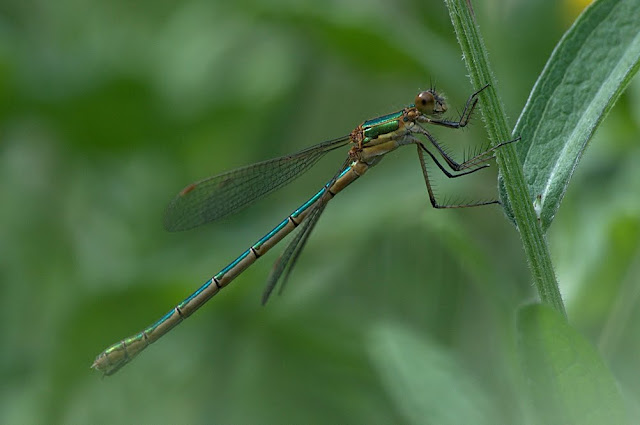
Female emerald damselfly?

I could have hung around a lot longer but I wanted to get to the a pond I can never find. With just one missed turning I found it this time! A couple of red admirals greeted my arrival. What I was hoping for were dragonflies and maybe a large red damsel or two. It was not to be. There was a one legged moorhen by the pond and plenty of blue damsels. Not to mention hordes of biting flies. Quite a few of the damsels were paired up. using all my stalking skills I finally got a decent shot. It would be better without the background rush stem, but it's a step forward.

Blue-tailed damselflies

I was tempted to stick around here and see what birds were around. Again I had somewhere else to go. A run around the forest, in the ancient sense rather than the large woodland sense, was in order. As the afternoon was getting on there wasn't too much traffic around. Before setting off I swapped the 70-300 for the 35 so I could take some landscape photos of the rolling moors, limestone walls and sheep the area is noted for. For once I was blessed by sunshine and scudding clouds, meaning my shots looked like the ones everyone else seems to get as a matter of course.

Somewhere in the forest

There were a few birds around as I drove along the narrow, twisting and undulating roads. Some were perching provocatively close to the passing car on drystone walls or thistle tops - pied wagtails and meadow pipits, and goldfinches respectively. Often they'd have beakfuls of food for their young. Of course these perching places always coincided with the narrowest sections of road - preventing me from stopping to get the camera out.

When I spotted a meadow pipit looking me in the eye as I climbed a particularly steep stretch I pulled over at the next opportunity. Getting the big lens out there were pipits all around me! Even so I was unable to stalk close enough to them for a really detailed pic. There was plenty of twittering and it was clearly a family group. I got the impression the youngsters were waiting for mum and dad on the wall when the coast was clear. At one time there were at least four either on the top of the wall or lower down on protruding stones.

By now the wind had died and the sky turned a uniform light grey. I crept alongside the wall, but the pipits had an exclusion zone, and whenever I entered it they would fly up and drop back further along the wall. I just could not get any closer.

Moorland meadow pipit

Near to where I had pulled off the road was a derelict stone barn, one of many in the dales. Often used by the moorland sheep for shelter in inclement weather this barn was the last resting place for one of them.

Dead sheep

My stomach was rumbling and  I headed home, stopping off at a fell that's closer to home for a bit of a look around for future reference.

Friday, 9 July 2010

The newt pond

The afternoon was free, so with the sun shining I set off for the newt pond, stopping off close by to investigate a farm track that I thought might have butterflies along it. Parking up I saw a buzzard swirling low over a field, but by the time I had the camera ready and got out of the car it had gone. Typical. There were a couple of small tortoiseshells on the path but nothing much else.. When I got back to the car the sun had disappeared like the buzzard. It was threatening rain too.

At the gate to the newt pond I chose to head the other way and have a look over the railway line into territory unknown. Although the public footpaths were obviously used there was hardly any signs of civilisation to be seen. It was like entering another world of little valleys and almost rolling hills. Unusual for this flat part of the county.

Another world

There was little in the way of wildlife at first glance, although I'm sure spending more time there would reveal it. There was an ex-hedgehog lying in a field of maize, flies of many sorts busy laying eggs upon it.

Recycling

Turning back I set off for the pond, which I knew would be sheltered and maybe there'd be a damselfly or two around. There were biting flies if nothing else. Although it was cloudy the air was muggy and I was sweating, my bare arms being a magnet for the blood suckers. The first insects I disturbed were meadow brown butterflies which proved as flighty as always. Flitting away as soon as I would make a move towards them from yards away. The gatekeepers were more obliging. Some settled with their wings spread, but always at awkward angles or behind leaves, making photographs a bit naff. One eventually settled, wings closed, long enough for me to sneak up on it and get a decent shot.

Gatekeeper

Making my way along the flattened path round the lake, avoiding the various droppings along it, I put up some damsels. Mostly they were blue-tailed, but some looked like azures. One, which I almost got a shot off but didn't, looked a little larger and decidedly less blue. That'll have to wait for a positive ID. I wasn't too bothered about photographing  the blue-tailed damsels but the azures I put some effort into. I got a couple of half decent shots, but the one I liked best was spoiled by a blurred blade of grass or something. It was interesting to watch one perched, arching its abdomen to, apparently,  brush its wings.

Azure damselfly

After spending some time inspecting deer droppings and looking for their tracks and paths around the pond, wondering if I might be able to hide up some time and photograph them, the rain arrived. Only a light, refreshing, drizzle. Quite welcome but not beneficial to camera equipment. Having nothing to protect the camera and flash with I hurried back to the car.

Tuesday, 6 July 2010

Bad timing and a tip-off

With rain forecast for late on I popped out on an errand at lunchtime, taking a camera with me and intending to catch some damsel or dragonflies while the sun was out. By the time I got to the litter pit the sun had changed its mind. There were a few damsels around the small ponds, and quite a few small skippers but I didn't get much that was any good. The male blue-tailed clinging to a horsetail was about the best. The emperor was in evidence, as was the one on the Litter Pit itself.

One that looked sharp on the LCD

While walking round to the bay where the emperor flies I heard a racket in the willows at the back of the path. It turned out to be two juvenile wrens, which perched close enough for long enough for me to get a clear shot of one. Even though the ISO was high with them being in the shade on a dull day they turned out not too bad.

ISO2200 with Neat Image noise reduction

The emperor was chasing around and proving impossible to photograph. The wind wasn't strong enough to force him to fly in a straight line and he was all over the place. He was also duelling with the mystery dragonfly, which I thought was a brown hawker. As chance would have it this was confirmed by a chap carrying out a dragonfly survey for the landowner. Chatting to him was enlightening, and he told me of two small ponds that are out of the way and worth a look.

A few minutes after we went our separate ways there were spots of rain on the surface of the pit. I beat a hasty retreat to the car. As I got in the rain eased off so I went to look for the new ponds - apparently dug for the benefit of great crested newts. They took a bit of finding, but they will be worth another visit on a sunny day. Not just for the insects but the birdlife too. I'll be able to sit a while and wait, hopefully undisturbed by other humans. While I was wandering around I saw a few damsels and watched another brown hawker chasing commas. There were quite a few other butterflies around too, not to mention bees and various flies. A nice secluded spot alright.


Thursday, 1 July 2010

Back to the litter pit

In many ways it's depressing visiting this pit, it's out of the way, well naturalised, but neglected. It also holds carp so anglers visit it. I won't tar them all with the same brush, the ones I have spoken to despise the duck-shooting, fire-lighting litter-louts too. There is a faction that insists on leaving cans, bottles, bags and more behind. It's such a shame as the place is everything a nature reserve would be if I had my way - unmanaged with no hard paths, just tracks that people have beaten out over time that follow the contours of the land and are overgrown in places.

As soon as I arrived there were chasers and emperors to be seen, then damsels. Reed warblers were being as noisy as reed warblers can. I walked through a clump of birches that had obviously been planted by the landowner, whoever that is, to find a burnt mess of a bed that looked as if it had been used as a barbecue. Yet feet away there were dragonflies and warblers.


Round the corner in a bay choked with Canadian pondweed carp were basking and chasers chasing over the surface. A large dragonfly came and checked me out, but I couldn't get a shot of it nor a positive ID. On the other side of the bay rudd were swirling in gaps in the weed. Then the sun went in and the dragonflies disappeared.


Bordering the pit, beyond the dense reedbeds, is a wild meadow filled with vetch, trefoil and other colourful plants. This harbours butterflies and moths in abundance. Skippers were spotted and burnet moths. And by the edge of a small pit, not much more than a scrape in the ground but one that holds fish, a common blue was briefly seen. Just for long enough to get a ropey photo with the wrong settings before I put the flash on the camera. I didn't see it again... The blue was perched on a mares-tail, which is prolific round the small pit and the two ponds which are mere wet depressions that are drying out in the current heatwave.


On the other side of the big pit is another, smaller, one which is rapidly losing the open water as reeds encroach from the margins. In the land around this pit I managed to photograph a burnet moth and a small skipper. One of these days I'll have to spend more time at this place, not least to see if I can get some good shots of the many reed buntings that inhabit the area. If only it wasn't quite so accessible and litter-strewn it would be truly idyllic. Of course, if it was well managed and the lowlife excluded from it I'm sure it would end up becoming manicured like so many 'proper' nature reserves. Sometimes you can't win.

Monday, 21 June 2010

Damsels here, damsels there

Yesterday I went for a drive around the Forest of Bowland, partly hoping to spot a flycatcher of the pied variety and maybe a dipper or grey wagtail on one of the streams for future reference and a return with the big lens when (if) it gets sorted out. It was unusually dry up there, the upper becks being little more than rocky gullies with a light trickle of water running down them. None of the target species were seen, and few birds of any sort to be honest. Plenty of young rabbits around, and two squashed stoats on the narrow lanes coming down from the fells.

In the evening I went for a wander by the canal looking for interesting insects and found some. A blue-tailed damselfly obliged, as did (what I now know to be) a Grypocoris stysi feeding on a fly. My proper macro technique is still wanting, but I'm not too bad on the close-up stuff.

Blue-tailed damselfly

Grypocoris stysi

With less wind than yesterday it felt even hotter as I ventured fellwards again, this time more locally. Parking up by a small mill lodge I walked round a rough field below the dam wall and followed the outflow stream back up, where I spotted a dipper perched on a rock under the culvert. I missed a shot of it with the camera. Mind you, it was dark under there and a photo would have been rubbish anyway.

One side of the lodge is boggy and rushlined, worth a look for damsels and other insects. So it proved and I managed a reasonable shot of a common blue, then it caught its supper and perched obligingly while it started devouring it, allowing me to get in close and take enough shots to ensure a keeper or two.

Common blue damselfly

Leaving the lodge I headed past a known spotted flycatcher haunt, failing to see one for the second time, and up to the start of the moors. I followed a path that stayed on a level and followed a stream at a distance. There were meadow pipits to be seen, feeding young judging by the beakfuls of insects. A couple of jays flew along the ridgeline, and as I approached a lightly wooded area a flock of great tits broke cover from the bracken and into the trees.

On my wanderings with the 70-300 I've started taking along the 35 in case anything appears which would benefit from a wider view. Heading along a bilberry covered section there was a lone tree set against the bright blue sky. I also happened to have a polariser with me, so I tried a few shots. This was a case of working towards teh best one by eliminating things and getting in closer. I think an even wider lens would have made a better pic, but I'm happy enough with the one below.

Moorland tree

Coming down the hill I followed the stream back to civilisation, the light being poor under the tree canopy that shades the path and with the sun dropping below the hills the camera was now redundant.

Monday, 14 June 2010

Streamside damsels

Back in July 2007 I took a picture of a damselfly eating another insect. It wasn't a great shot. yesterday Mark Houghton blogged a picture of a banded demoiselle - the same speices of damsel. As I knew there were plenty to be found along a stream near the dragonfly pond I nipped out after boxing off what work I had to do by lunch time.

The lure of the pond was hard to resist and I took up the challenge of shooting a dragonfly on the wing. I left defeated - for now. It's a task that requires a concerted effort. On reaching the stream I was wondering where to start my search for the iridescent beasts when two males flew up before me. Starting the theme for the afternoon they steadfastly refused to settle anywhere where they were unobscured, or if they did they were at an inconvenient angle. Rather than hang around waiting for a good opportunity I went in search of more demoiselles.

Although country parks and local nature reserves are a public amenity, and often habituated by errant canines and children, they do have the advantage over more 'serious' nature reserves in that you can wander off the hard paths and are not restricted to looking at the wildlife through hide windows. So it was that I followed a lightly trampled path along the stream's grassy bank.

More damsels flew up and I soon learned to tread more carefully. In some spots there were many damsels to be seen. One was sure to land and pose nicely. It didn't. I managed a few half decent pics, but in most the damsels were partly out of focus because of the angle of their bodies, or there was a leaf partially hiding them. The sun had also disappeared, although the light was still good. Not that that mattered as I was shooting using flash. After a brief bee interlude I wended my way back along the stream.

Female banded demoiselle

On reaching the bridge where the path back to the car leaves the stream I took one last look at the spot I'd started in, but from the opposite bank. Two male banded demoiselles appeared and one landed in a perfect pose. I took a few shots from afar then moved in closer. It stayed put and I was able to get in as close as the lens would allow. Knowing I had at least one good shot I bid the poser a fond farewell and called it a day after a last look at the pond. The chippy beckoned.

 Male banded demoiselle


Monday, 7 June 2010

It's been a while

The bird photography took over for a long time, but the close-ups have been getting more attention lately. No diopter used, just the 70-300, sometimes in 'macro' mode, sometimes not.