Showing posts with label cameras. Show all posts

Monday, 13 May 2019

Decisions made

Sunday saw me dragging myself to the egg show without much enthusiasm, or hope for getting any decent pictures having been there before. My main reason for going was to make a final decision about cameras/sensors. I took two small cameras and a big one with a smallish sensor. The light in the village hall isn't too bad so it was as much a handling test as anything.

Even with the reasonable light I came to the conclusion that for any indoor photography without additional light the big ol' sensors win every time. The cameras might not be unobtrusive, but as I repeatedly discover, that doesn't matter. It's big lenses that put people on their guard.

All three cameras did OK, although the one I used least might have been down to focal length more than anything. Even so that was the camera which took my favourite photograph of the day! The 90mm equivalent focal length seemed natural to me despite thinking 30mm equivalent might have got more use. The camera with the zoom got most 'keepers'. Again, not much of a surprise as the tilty screen was used a fair bit.

Although I thought I'd seen everything there is to photograph in the egg judging world the 'level stick' was new to me. That made the visit worthwhile on its own. And I got a decent shot of it in action. 


Final decision? Stick with the full frame DSLRs - even if they aren't fashionable in these days of mirrorless transition. They work, I have the lenses I like. No need to change. The Fuji, yet again, pissed me off with its clunky in-out-shake-it-all-about focussing. It's gonna have to go. I can understand why rangefinder users like it - they're used to a slower way of shooting. In that respect it is quite like the film shooting experience. But times have changed. When the subject isn't going anywhere fast it makes nice files though.


One from the smallest camera to prove that at screen sizes there's nothing to choose between any sensor, even at higher ISOs.


Another reason for my lack of drive to get out on Sunday was having been at a sheepdog trial the day before. That had been another exercise in camera evaluation. I got myself another APS DSLR body to give me a cheaper way than buying a longer lens of getting more reach for photographing sheep dogs in action. I ended the day wishing I hadn't bothered.

There were two reasons for this. Firstly the camera didn't seem keen on focusing on distant things at the full length of my cheaper zoom. The lens I was hoping to weld to the camera. At close range or shorter focal lengths it was fine. With two different lenses it was fine. For some unknown reason it improved performance after lunch and started producing acceptable results. I have no idea what was going on, it might have been something to do with the focus modes I was using.

Being in trial (pun intended) mode I had other gear with me. I was also seeing if the Fuji might work as a second camera for this sort of event. I took two shots to start with then put it away for the day. It really doesn't work for me. My cheap and cheerful mid range zoom, on either an FX or DX body on the other hand works great for me. Better on the larger sensor. That decided me to stick with it as my outdoor go-to lens for the summer rather than rely on the do-it-all superzoom. The second body might get a longer zoom, or simply my 100mm.


The day also served to convince me that photographing sheep dogs going round the trial field isn't my thing. If I was a mad keen trial person then it probably would be, but as I'm interested in making decent pictures there's not much scope and it relies on long focal lengths which don't make my kind of pictures most of the time.

That said, I was able to get a couple of decent driving shots when the dogs took the sheep to the exhaust gate as I was able to stand near to it with the slope putting me at sheep level - saving the old knees.


Of course, long focal lengths do have their uses. I find them handy for pictures of dogs, and handlers with dogs as they both give separation from the background and keep me away from the subject so they don't notice me. Although that latter point is moot.

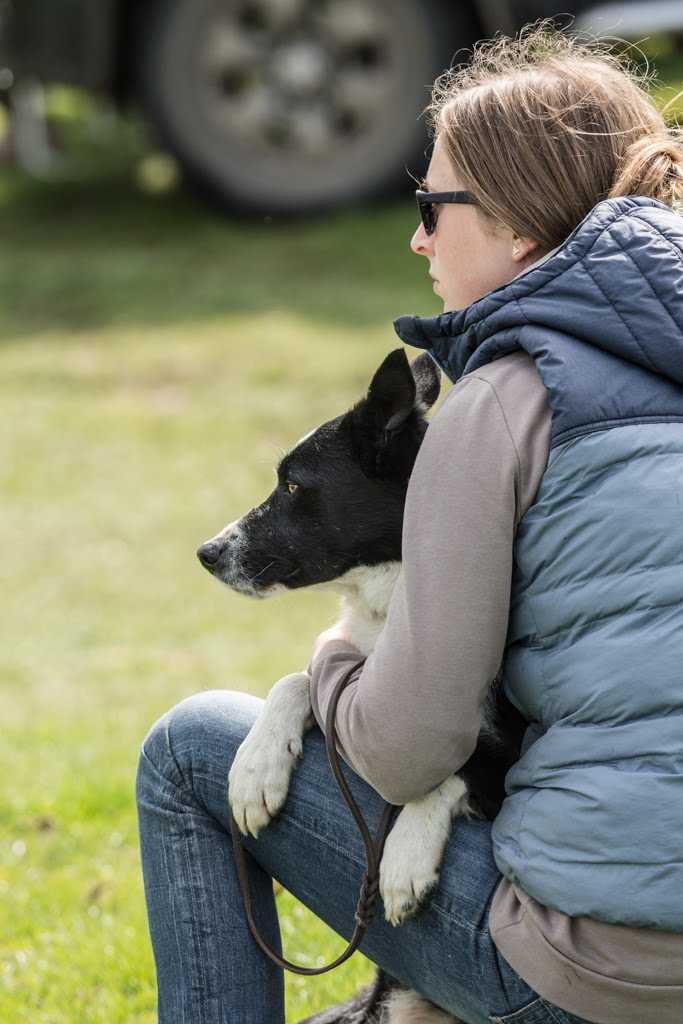


I struggle to find detail shots at the trials. However I made a pair of pictures to show a fancy crook and a practical one.


I'm posting the next two pictures because the second one was the result of me persevering for longer than I often do in the hope of getting a better picture. It's not perfect. I'd have liked a sheep dog and sheep in the distance, but it's not too bad of its sort.

What drew me to the scene initially was the two men and their dogs having a near symmetry. I positioned myself to get the judge's 4x4 in the frame and the handler (he's 92 by the way) at the post. The first frame here (I took a few more) was not too bad but I moved a little to my left to separate the vehicle from the chap on the left. Then waited until both dogs were looking at the sheep.

I was hoping to get both men in profile, as they were chatting, but settled for one. It wasn't until I got the pics on the PC and was toggling between the two I thought worked best that I realised that the guy on the right had crossed his legs mirroring the pose of the other chap and making the picture. I'm not sure that having both faces in profile would have improved the shot. It might have been too 'static'. It's funny how little things in pictures can make big differences. Something else I only noticed later on was that the right hand dog lead is a contrasting colour to the bloke's jeans. Nothing much, but it helps the story, I think.


I'm not sure why but I prefer photographing sheep being driven as a flock rather than as small packets round a trial field. When it was time to gather them up to take back to the release pen I was almost in the right place. Getting the three elements - sheep, dog and shepherd - together is down to luck I reckon. One of those subjects to keep trying until it clicks. The sheep in the background were a small bonus.


The way back to the release pen was up the narrow lane. While quiet a flock of sheep on the tarmac destined to attract a car or two.


A busy couple of days which have convinced me of a way forward to pare my gear down. The Panasonic is going in the fishing bag, the Fujis are just going. The DX body is going to stay for the time being. If I can fathom the focus issue it'll be worth keeping for anything I need maximum reach for in good light, and possibly with a couple of small primes as a knockabout camera.

I'm keeping my 'pro' zooms mostly for rainy days as they have better weather sealing than my 'consumer' zooms and for low light situations. The mid-price zooms will become my staples for outdoor use in fine and sunny weather. My big resolution is to concentrate on the middle range of focal lengths as I think they make most of my best pictures. Forget trying to cover all bases and home in on making good pictures of a more intimate type.

Open trial season is well under way now with plenty to choose from, including tow and three day trials. Agricultural show season has also kicked off. Will I stand the pace or am I already running out of steam? Time will tell.

Monday, 6 May 2019

Indecision and a pilgrimage

It's been a case of no free time at the right time recently. Which has put me at a bit of a loose end. One day last week I decided to carry out an experiment to see which camera of three might be the best option as my 'street' camera. It turned out to be my fishing compact. It focused faster, which was important, and its limitations weren't a hindrance. In second place was my ridiculously expensive compact (which I got at a bargain price). That is as slow to focus as the camera I bought for 'street' photography but smaller and I think the lens is better, or at least I prefer the look of the files it produces. In third place was the camera which should have been best, but for all it's niceties, doesn't deliver the goods.


The Fuji X100 series of cameras trade, I reckon, on their looks and design. I really like the way they are laid out - with one exception. Back button focusing is a fiddle with the button being awkwardly placed for my thumb. I could adjust if it was worth it, but the focusing is too slow for me. Time to get rid in order to stop me using the damned thing. Time to trade methinks.

Stuck for ideas today, a Bank Holiday, I set off fairly early to sheep country. I couldn't decided what lens/es to take. I was tempted to go for the simple option of the super-zoom and 20mm combination, which covers all eventualities, but ended up thinking I'd force myself to look differently with the ultrawide zoom and two macro lenses.

My destination were two of the dales which feature in John and Eliza Forder's books. Apart from the main village which was a little busy they were both very peaceful and there were Swaledale sheep everywhere.

My first stop was pretty random but gave me a chance to get some elevation without having to climb too high. 18mm was too wide, 35mm not long enough. I put the 60mm macro on and found it makes a good landscape lens! Not everyone's idea of a landscape photograph having buildings, road signs, a road and a cyclist. And it was taken around midday! But it's my kind of picture. Deserted landscapes pretending to be of remote places bore me rigid.


Walking back along the road there was bank of ramsons. I spent some time taking rubbish photographs of them with the drystone wall as a background. With subjects like this, particularly hand-held, I struggle to decided what should be in focus. At a small size they are OK, but zooming in reveals the lack of depth of focus.


Walking the other way there was a subject more suited to my lack of technical know how. Felled timber.


Here I didn't find the wide angle a limitation. It actually proved to be about right as there wasn't much space to work in. I liked the idea of showing the cut trunks with the standing timber as a contrast, both visually and conceptually.


The addition of the drystone wall added a third textural element.


My plan had been to stop in Dent and have a wander round but when I got there and saw there were two packed campsites I didn't bother. So much for the pilgrimage. I might return in winter.

With no other plan I carried on up the dale. The narrow roads weren't conducive to random parking so it wasn't until I reached the viaduct at the dale head that I pulled over. Once more an ultrawide lens came in useful. Even if the picture isn't up to much.


Under the viaduct and up the pull out I saw a couple of people taking phone shots of the viaduct. A glance back showed why. The view is pretty good. I stopped in a passing place and immediately wished I'd had the superzoom, or at least a mid-range zoom. As it was, however, being stuck with two focal lengths forced me to find a vantage point which suited one or other of them. As a result I spent more time thinking about framing the shots and ended up with a couple which aren't too bad. Some sheep bottom left would have improved them...


Talking of sheep, a longer lens than 100mm is really required for sheep in the wild. Which is one reason for my sheepscape series. Although there were thousands of sheep about I didn't spot many situations for sheepscapes. Not where I could park up at any rate. One of these days I'll go prepared for this and do some walking. Maybe.


Back home and after culling the crap I was struck by how much detail all three lenses were capable of resolving. Even the ultrawide zoom - which also has out of focus rendering I like. On the drive home I was thinking of selling it as it doesn't fit my usual subject matter or my way of looking at things. Now I'm not so sure. Then again, how often do I need to go wider than 24mm? Not very. A quick check on the focal lengths used in the pictures I haven't deleted which were taken with this lens eight are wider than 24mm and 20 were at 24mm or longer, 35mm was the most used focal length with 12 frames. Logically the lens could/should go.

In one way I wish I only had one lens. A 24-120 would probably suffice for me if I'm honest. Or even a 24-70. The old adage of the fewer choices you have the more creative you have to be springs to mind. First world problems, eh?

Sunday, 28 April 2019

Three strikes and out

The weather forecast for yesterday was both horrible and accurate. The day started cold and wet and got cold, wet and windy.My original intention had been to go toa rare breed auction in teh morning and call in at a sheep dog trial on my way home via the tackle shop I wanted to photograph to complete the project started before they moved. Part one of the plan went well. As far as getting there and taking photos was concerned. Today I took the 'toy' camera to the auction auction knowing that the light there would be reasonable enough for the camera to cope at fairly low ISOs. I still felt like taking a hammer to it when I got home!

I don't know if I'm unusual, but I often use a camera's ability to select the focus point for me. I work on the assumption that it will focus on whatever is closest to the lens. If I'm photographing a group of sheep then the sheep nearest the camera is the one I want in focus. Saves me moving the focus point around. The camera does this just fine. Except... Whatever focus mode it's in if you touch the screen it switches to single point. Either my thumb is too big or the camera is too small but it was forever going into single focus point mode when I didn't want it to. It also defaults to 1/60th when in aperture priority and auto ISO. Once I realised this (after far too many shaky shots) I stuck it in shutter priority and stopped the motion blur. High ISO noise wasn't too bad lifting detail out of shadows at higher ISOs is not a good idea.


The tilty screen does make lamb-level shots easier, and using a camera with no viewfinder can be useful for candid shots of people. Although I prefer using a viewfinder even close up.


Playing with a couple of frames which didn't stack up in colour I found that black and white conversions worked OK as the noise isn't as distracting as it is in colour, and I think there's a perception that detail can be lost acceptably in black and white as it is using grainy film.


With enough light the high ISO shots are fine in colour. It's dingy environments where things start to go down hill. I'll give the camera a go at an agricultural show and see how it fares there. For indoor work it's back to the search for a tilty screen camera.


The sale itself didn't hold my attention for long. It had stopped raining too so I set off to stage two. Having got rid of my very-ultrawide lens I was going to be restricted to 18mm at the widest to take some indoor shots. I tried using available light, but ended up shoving the dreaded flashgun in the hotshoe and bouncing it off the white ceiling. It helped even though the space was  quite large. I'm not sure how the toy camera would have coped.


On the road again and no sooner had I arrived at the sheep dog trial than the rain came back. With the strong wind blowing it looked like it would soon blow over. When it did I got out of the car. Took two snaps and got back in teh car. It was bloody freezing! With all the dog people huddled up in their vehicles there wasn't much to photograph anyway, so I buggered off home.

Apart from wrapping up the shop pictures it felt like a bit of a wasted effort. Although learning the limits of gear is helpful as it stops me trying it in situations where I might have a chance of some different pictures. The ones I got wouldn't have been any better as pictures no matter which camera I'd used.

Back home and the culling was easy. Half the auction pics were blurred beyond my level of acceptability. A load more got dumped because I'd been shooting in burst mode and they were no more than duplicates. Then I finished off the Blurb book and ordered a copy as a proof before the latest discount code ran out. With that done I searched around for a way to reduce the size of a PDF file I'd made for a trial A4 booklet/zine and with that done uploaded it to an online PDF print service. Making hard copies is something I'm trying to do more of. Either book/zine things or plain old prints now I've found an album which makes it easy to change the contents as a sort of portfolio.

Tuesday, 16 April 2019

I never learn

In a fit of madness I got myself yet another camera with horrible reds. The trouble is the bloody things tick all the right boxes on my 'camera for wandering round town with' spec sheet. Except for the way they render various shades of red. First time out with the thing and the reds hit me straight between the eyes as soon as I loaded the files on the PC. After a bit of fiddling I've made a profile which tames them a bit. Today's search for red things to test the profile was fruitless. There was nothing red to be found! I'll give it a few more goes before throwing the camera at a wall.


The main reason for buying the camera was to get a tilty touch-screen. This does work well. Apart from it being too easy to touch the screen accidentally. As the camera has no viewfinder the use of the tilty screen automatically lowers the viewpoint, making it similar to that of a twin lens reflex camera, or any with a waist-level viewfinder, from the days of film. This makes you less obviously photographing when around people.


Reds are easily sorted in black and white. If only I could find a project to justify black and white conversions. Doing them just for the sake of it is a bit naff. Even worse if it's done because 'street is best in black and white'.

The bus station, however, is mostly black and white, so conversions don't lose much, in fact they rather enhance the graphic nature of many photographs taken there. Although sometimes a small touch of colour works too.


One unexpected advantage of a tiny camera, and this one is tiny, is that it could easily be held at arms length as I leaned over a railing to take a couple of shots of the interior of what was the art school where I did my foundation course. The place has been deserted and up for sale for a few years now. A shame.


Or held up high to another window. The windows were very grimy, hence the soft look to the pictures.


The lens I got with the camera is nice and compact, although it does distort a lot at the wide end which isn't a big deal for people pics but not so good for architecture.

The dilemma now is to persevere with this latest small camera and ditch the Fuji, or look elsewhere for the perfect little camera. This one would be fine to take fishing. My fishing compact might be better for taking anywhere. Decisions decisions. So far no camera I've tried has been as easy to use as a DSLR, although teh fishing compact comes close. Maybe forget the quest and stick with one of those great big lumps!

Sunday, 24 December 2017

The end is nigh

The 'toy' cameras had to go. Nothing wrong with them as image making machines, I just found them impractical with the annoyances outweighing the advantages. When the quote I got for the lot was more than I'd anticipated I gave in to a GAS attack and instead of taking the money and running went for a trade in on a camera I've fancied for some time. I liked my Fuji X10 only getting rid of it because I wanted a flip out screen for fishing. I almost really liked the Fuji XE-2. But there is something about the X100 series with it's fixed lens that has always appealed. Probably to a sense of nostalgia more than anything. The original model was noted for being sluggish in the focusing department, which put me off when it was relatively new. But Fuji seem to make improvements to their new models rather than alter them for the sake of it. The third generation seemed to be much improved and with the fourth now available it was affordable.

When the used X100T turned up it lacked a user manual and a lens cap. Manuals can be downloaded for free as PDF files so that wasn't a problem. Lens caps are fifteen quid! Luckily the camera did come with a lens hood and a thumbrest. The lens hood allowed me to screw in a near 40 year old skylight filter to protect the lens when the camera is in my jacket pocket or rattling around in my shoulder bag. The thumbrest looks like a gimmick but makes holding the camera with one hand really comfy and feels secure.

Batteries charged and off I went to the beach yesterday. It being the last Saturday before Christmas there weren't many people around for me to pester. The upside being that all the shots which went wrong due to my unfamiliarity with the new camera were just random snaps. One mistake, however, had something about it and with some heavy processing gave me an idea for a short project. All I need is bright, low sun. So that'll be the end of another project idea!


One my way back to the car I took some of my 'pictures of nothing interesting' shots, and found the camera ideal for them. I can see it might be useful for my jaunts around town. It's snappier to use than the upmarket compact I was using before the 'toy' cameras. That can go back in my fishing bag for the time being as the idiot-proof camera I can had to passers by.


Having had time to evaluate the results I was keen to have another outing with the camera and set off for the beach again on Sunday morning. I didn't make it. There had been big changes at the sandplant which I hadn't noticed the day before. If I had spotted them I'd have packed some more appropriate gear. One camera with a 35mm equivalent lens and another with the 85mm lens I don't get on with attached wasn't my ideal choice.

If I'd had a wider lens with me I'd have made different pictures, but as it was I don't think I'd have made any better ones. Taking a lot of pictures, even knowing that most would be deleted, over a short space of time while thinking about what I was doing proved a good way to learn the camera. I came away fairly happy with the way I had it set up and reasonably fluent in using it. No major niggles causing frustration as was the case with the toys. One nice feature is that by pressing and holding the 'menu' button most of the buttons which might get pressed accidentally can be locked, while others still function. While the electronic viewfinder is good, it can be switched off and an optical one used. Nice. It feels like the camera has been designed by people who use cameras rather than electronics geeks.


The changes at the sandplant look very much as if the final layout of the place has been settled on. The bund which was across part of the flat area has been extended, the sand and debris on the seaward side removed and the whole area towards the saltmarsh cleared and levelled. There is now an embankment surrounding a flat area on the same level as the road. Large piles of sand waiting to be removed are inside this area.


The last brick building has been demolished and the scrap metal collected in a pile. It won't be long before the work is complete. Then we'll have to wait and see what happens next. I'm sure the birdy people would like to create another eyesore, sorry, visitor centre... More pics, which I doubt a different camera would have made any better, here.


A quick visit to the beach saw the cameras pretty much staying in my bag then back home for lunch and a look at the results. Content and with still plenty of life in the battery I thought I'd head to sheep country as the forecast for Monday was one of rain.

I went armed with the same two focal lengths as a challenge, and because I was mostly scouting rather than seriously looking for pictures with the day still overcast. However there were plenty of sheep about near where I parked. But they weren't up for a photoshoot. I tried to do some 'arty' stuff suggesting what the area is like. It didn't come off too well.


Then I went somewhere else I didn't expect any sheep but thought I'd have a look around anyway. As I started walking the sun came out! They are difficult to make out in a small rendering but there are sheep on top of the hill behind one of the most photographed dwellings in the Chorley region.


Although it's at the foot of the moors this is a former industrial area. The stream which flows down from the hill has been channelled and managed by sluices in days past to fill a chain of lodges. Three are no more, one having been drained quite recently. There are plenty of relics of this water management system still to be found. If it was the sort of thing I could get into photographing it would make for an interesting project. But it's too much like landscape photography, and too dependent on the light for my butterfly mind to cope with. I still enjoyed blundering about looking for angles to make pictures while the light was 'interesting'. Again, I used the new camera finding it capable and not annoying. A flippy screen might have helped, but you can't have everything!


So far the camera is proving usable, but the real test will come when I try it at a poultry event or similar. That won't be for some time though and I'd like to give it a dummy run somewhere before hand, but  can't think of anything going on which might be suitable.