Showing posts with label flash. Show all posts

Saturday, 5 June 2021

A slow month's catch up

May was very wet, which hampered my wanderings. I still got out round the moss when dry weather and spare time coincided and found some useful photographs. By the end of the month, however, it was obvious that my enthusiasm for following the same routes and photographing pretty much the same things was waning.


I did manage to get a few 'work' pictures, which are more interesting to me than the unpeopled pictures. taking that sort of photo from afar, as the ditches force me to, isn't ideal and I do wonder if they are worth taking because of that. Still they do show what was going on. In this case a low tech way of feeding out insect netting.


Among my pictures of inanimate objects were one of a Mylar strip bird scarer which I think might be 'the one', and a series of pictures of a hoe.

I took a variety of pictures of the how from different angles using different focal lengths and apertures. The one I like best being the simplest one. The overhead shot which showed most clearly the cobbled together nature of the hoe using the insulation tape..


Having brought this project to a conclusion in my usual way (getting bored of it...) there is now a zine in production of a selection of geometric field photos and I should make an effort to put some order into all the photographs I've taken over the last twelve months or more. Maybe even make some prints.
 
The end of May saw dry and sunny weather return and the restarting of sheep dog trials. My enthusiasm for the trials had already begun to dwindle when they were stopped last year but the chance to go and photograph some people from closer range than on the moss wasn't to be turned down.

The trial I planned on going to was a four day event and I had intended to be there every day for a few hours at least and all day for the finals. As it turned out I couldn't make the second day and the first one had proved less than inspiring. The third day I knew I could only manage a few hours and almost didn't bother but got back into the swing of it and got a few pictures which were worth having. In particular the one of the dogs watching the action while a human uses her phone, and one of the event being live-streamed which was a cut above the more pedestrian shots I've taken of this subject. This encouraged me to make it for the fourth day. 


Unfortunately a combination of the heat, it was the hottest day of the four, and a trial where the close range action at the pen and shedding ring was only every half hour or more lead to a lot of slack time.


In truth the dog/sheep action doesn't really fire me up but there wasn't much else to photograph that I haven't photographed before. Maybe the heat had got to me too as I felt lacking in energy. I ended up sitting most of the day out in my car watching the trial and checking the cricket score from Old Trafford.
 
While I might not have been adding much to my documentary archives this last month what I have been doing is playing around at home with artificial light. I think this was really the result of a bout of retail therapy (or gear acquisition syndrome!) had struck me after selling some lenses. My justification for the spending spree was that I wanted to improve the photographs I occasionally take of the fishing rods I make. After much faffing about and buying the wrong stuff I've managed to get close enough to the results I've wanted to achieve.

I'm sure there are many faults in my results but they are only intended to serve as illustrations of what things look like. In truth the people who see them probably couldn't care less about how good or bad the pictures are. Phone snaps would do well enough!

With this new gear I thought I'd try some selfies. I've been reading threads about studio portraiture and lighting on Talkphotography for years now and have always been baffled by the technicalities and underwhelmed by the results. Having always been a 'learning by doing' kind of person I found messing about with the lights and seeing results much easier to understand than being told an understanding of the inverse square law was essential!

Two other things also became apparent. Firstly I like the kind of flat light that the experts seem to despise. Secondly when dramatic/directional light is used it isn't what makes a portrait work. As I keep trying to tell people, good pictures are not all about the light. No matter how good the light is if the subject is rubbish the picture fails. In the case of portraiture it's expression and gesture that are most important, lighting only serves to improve and already good picture.


While I'd quite like to photograph other people using lights I still don't find this kind of formal portraiture all that engaging. I much prefer a documentary/environmental style where the relationship of the person to the location is important. All I need are some opportunities to take that kind of picture. Which is where I struggle.

Saturday, 20 March 2021

Artificial light

It must be lockdown boredom that drove me to spend money on yet more flash equipment. It was either that or another guitar, but the axe I fancied was out of stock. Hopefully it'll be available when we can go to real world shops and I can trade a couple of unloved guitars for it. In the meantime it's playtime with lighting.

Without going into the details I got myself some new flash triggers. The ones I bought last time I was going to be the next Rankin never worked consistently for me. These new ones do.My wafer thin justification for the purchases was to use them for taking product shots for my business. Obviously that meant my first try out would be to photograph the frogs in my pond...

I'd taken a few shouts using the pop-up flash on my compact and thought I'd try to get a bit tricksy with more versatile gear. One trick was turning day into night by messing with the ambient exposure and zooming the flash to highlight a frog. It looks artificial, but that was the point.

Using the flash gadgets got me thinking that there are some aspects of photography that attract people who like fiddling with gear. There is a large subset who use artificial light almost exclusively. As well as the gear fiddling side of things I think they also like being in control. While I'm as attracted to gear as the next man (I think this is predominantly  a male thing) it's only up to a point. 

When it comes to using flash I've been reading and watching stuff on-line for years now and the theory still makes no bloody sense to me! I understand the concept of the ambient and artificial light being dealt with by two exposures, but the way it's always put forward to get the results you want is to set everything manually. This is where I come unstuck. The experts all say it's dead simple. But there are all these numbers to deal with. Although I did maths and physics A levels I'm still baffled. I've found my own workrounds. They'll do for me.

Thinking about the different types of photographer there are also got me pondering what attracts people to photography. I initially picked up a guitar because I liked the idea of being a guitar hero. Not because I had a burning desire to write music. Is this the same for some in photography? Do they secretly want to live the imagined rock'n'roll lifestyle of a David Bailey or a Rankin? Or maybe travel to exotic places photographing dramatic landscapes? Some, I am sure, just like playing with cameras, filters, lights and so on. None of that appealed to me. I started taking photographs because I wanted to make pictures.

There's been more opportunity for doing that this week than of late. Not that there's been much to look at on my mossland walks. A drive out to the shops saw me stop on a sunny day and grab some shots of a field being prepared for planting and fleece covering. The light on the plastic sacks and wet tyre tracks made this picture.

 
But it took a short trip to the mere to find some pictures worth making. A couple of hours walking roads I usually drive proved quite fruitful and got my 'eye' back in. I'd been getting stale walking the moss and seeing nothing had changed. Things were more advanced out on the edge of the mere.


After that it was back to playing with the flash again. This time indoors doing what I supposedly bought it all for. Photographing 'things'. Not having any products I needed photographs of I dug out some cameras I've inherited and used them as my models. I even set my tripod up and locked the camera down on that. Once I stopped even trying to think about the numbers and did it 'my way' I was soon getting results I liked. They might not be what the experts like, but when I've looked at their pictures I don't like them. The aim of using artificial light all too often seems to be to make the light the subject. All dramatic chiaroscuro and  (what they tell you) modelling to show texture and make things look better than they are. The advertising/commercial approach to photography. Selling an idealised dream to folk. Just as I prefer overcast days for taking landscape photographs I prefer my 'objects' to be more flatly lit. Some shadow is required to suggest form, but drama can get lost for me.


This line of thinking prompted me to consider the photographic portraits I prefer. Oddly two photographers who sprang to mind were Martin Parr and Rineke Dijkstra. neither uses the kind of lighting the on-line mavens promote. Parr uses on-camera flash with a dome diffuser, and from what I have gleaned Dijkstra uses a single strobe and umbrella positioned almost straight on - at least for here well known beach portraits. In both cases what appeals to me about their photographs is the subjects - their look, expressions and gestures. Which rather suggest to me that those are the things which matter most in a photographic portrait.

Think of the famous Karsch portrait of Churchill and it's not the lighting that makes it memorable, it's Churchill's expression and pose - famously created by Karsch removing Churchill's cigar from his hand. Subject trumps light every time. Or at least most of the time unless light is the subject.

As I delve into this flash lark my aim is to find a way to use it to eliminate shadows more than to create them. The opposite of what the experts keep telling me to do! But as someone once said, I'm not a normal photographer. Normal photographers don't see sticks in fields as a subject for a project!


This is another photograph which tells a story to those in the know. The stick is a marker, and look closely to see small red and white dots on the earth. Two types of fertiliser. Another picture which may benefit from the addition of words. It certainly wouldn't benefit from the addition of flash!

The zine swap deadline draws near. I think I have mine finalised. More a case of abandonment than completion. I'll get a back-up printed of something else too. Just so the other swappers won't feel like they've been cheated or I am taking the piss...


Sunday, 11 September 2016

Shaving a pig

Although I didn't achieve much photographically at the poultry show today I did learn the best way to scrape a pig's carcass of hair! As well as the judging pictures of poultry prettification are also scarce in my files. I got there rather later than planned, but still in time to get a couple of pictures. More are still required, although how to convey what's going on with the baby oil and mysterious white powder is the big problem.


One reason for going to the show today was to drop off a couple of prints I'd promised someone. When I arrived I hadn't expected to see the chap I'd photographed sitting on a specially reserved chair at the Lunesdale show, so I popped home and made a couple of prints of the photos I'd taken and fetched them back for him. It's always nice to give something back, and people do seem to appreciate physical prints in this age of electronic media.

I spent a quite a bit of time in the village hall during the judging, eating a sausage barm and drinking tea while listening to talk of things other than pig killing. The state of country shows was one subject discussed, and I'd agree that there is more stress on entertainment and selling things than on livestock these days. I guess that's the way to make the shows pay, by attracting non-farming folk. Then, as the results began to filter through, it was 'eyes down and look in' as notes were taken.


When all the judging was completed it was back to the show to see which birds had won and the post mortems begun! Much consternation among the Orloff fraternity as an unknown owner had got first. Who could it be?

As the regular photographer is recently bereaved he wasn't present and I got asked to photograph some of the winners and the presentation of trophies. Not something I'm skilled at. And equally unskilled at using flash, which I had with me and thought might help. In some ways it did. Mostly in eliminating camera shake and twitchy bird movements. My efforts were not what I'd describe as a threat to the legions of poultry photographers! Pedestrian at best, I would say.

What I did get out of it was a better understanding of how to get people to pose. The chickens take instruction less well. I also understand that I need to pay more attention to backgrounds and not to rush. The whole artificial light thing still befuddles me. I still prefer the results I get from doing nothing fancy than when I try to do it 'properly'. Even so, I got one picture I'm almost satisfied with.


Using flash does have some advantages in the dimly lit shed. I didn't have to worry about the shutter speed and the white balance problems it causes from the fluorescent tubes, nor was getting sufficient depth of field and issue. However, it does make the pictures look more 'journalistic'. Swings/roundabouts. Not much achieved today, but lessons learned for the future, perhaps.

Three o'clock and it was time for the raffle and presentations. The raffle is treated with almost as much seriousness as the announcing of the winners!


 Finally it's time to gather the birds and the day is over.


Thursday, 4 June 2015

Messin' about

Nothing much to report owing to work and fishing. At least the fishing was slow, allowing me to play around with some 'selfies' and other stuff for a bit of fun. Taking photographs in the dark certainly finds the limitations of your gear and my fishing DSLR is a bugger to focus with when there's barely any light. For the first shot I hung my head torch on the brolly, zoomed in on it using live view and focused manually. I used a radio remote to take the shot.


In daylight things were easier, except for some reason the camera used face detection to pick the focus point - even with the distant face - when I wanted the reels sharp. Once more the best shot of the bunch was the one with the dodgy focus and the ones where the focus was on the reels were rubbish because the light had changed.


Next time out I tried some light painting using my head torch as an experiment to illuminate the rods. Difficult to pre-visualise the results at first, but I find it far easier than using flash. You might think that spending twelve hours in one spot trying to catch fish would mean I had a high boredom threshold, but I gave up on the photography long before the moon moved round to the perfect place in the frame because it became tedious!


At dawn I spotted (ho, ho) a four-spotted chaser waiting to dry off and warm up before taking flight. So I pestered that with both fishing cameras. The best results coming from the compact. Not great by most standards, but acceptable for unplanned pictures. Especially as the only flash I had was the one built in to the camera.

Using the flippy screen I was able to get better angles than the awkward ground allowed. I'd have got a dunking had I tried to use the viewfinder for framing. Rather than go for the usual out of focus background I was trying to make environmental pictures. Even so I could have cleared some of the dead reed stems out of the way as the insect wasn't going anywhere. Again I gave up before I got a really good shot. I don't have that urge to pay attention to every detail and strive for perfection. Story of my life really. Near enough is good enough for me most of the time!


Despite this lackadaisical attitude I have learned a few things. So maybe one night, or day, I'll be able to get some better results from the gear. If I do some pre-planning. Which is unlikely...

Saturday, 28 July 2012

Unexpected directions

There's this gutter on the marsh, right by the road, that has always cried out to be photographed at sunset. Such is it's alignment that right now is probably one of the two annual windows when the sun sets more or less in the ideal place to get it reflected in teh water. With there not being many sunny sunsets of late I took the opportunity yesterday to give it a go.

I didn't expect it to be easy to make something of it. Ideally I'd have got a higher vantage point to take in the pools further out on the marsh, but that didn't seem to be practicable. I spent quite some time, making a lot of exposures, until after the sun had left the sky. One was half reasonable. The best light and cloud combinations all came when the sun was not in the best position.

I used a convenient fence post as a monopod, but I really ought to use a tripod for thsi sort of stuff. It's just that that seems like taking it all too seriously to me. It also kind of commits you to picking one composition and sticking with it, which goes against my impatient nature.


On my way to the gutter I got an idea to photograph the wildflowers growing by the side of the road putting them in the context of their situation colonising the man-made environment. It seemed a reasonable idea to include the traffic, slowing the shutter speed to provide motion blur. A couple worked quite well and it's something I might do again.

With the light failing as I walked back to the car I popped a flash gun on the camera and messed around balancing the artificial and ambient light. In the old sand-plant this gave me my first real concept of how to photograph it's recolonisation by plants. I don't know why the use of flash at dusk makes the photographs work better than ones taken of similar subjects in daylight. Perhaps it's the contrast of light that highlights the contrast of plants against bricks, concrete and rubble. Again this is something that really requires a tripod to get sufficient depth of focus with the slow shutter speed required to expose for the sky, and probably off-camera flash, to do justice to.

Both these ideas are the sort of thing I could imagine a student working up into a project accompanied by a lengthy statement justifying the subject and practice and coming across as ever so intense and pretentious. They're just photographs of an interesting idea to me. I've made a few, so I'll probably leave it. I find that when you start realising what you are doing things become stale and samey. It was the spark of inspiration that lead me to try the two techniques out on the subject that really interested and excited me. Doing it again and again until I get the 'perfect' shot or shots sounds too much like the tedium of work. Although they do say genius is 10% inspiration and 90% perspiration. Sod that for a game of soldiers!.

What the evening's events did bring home to me is how it's good to have techniques up your sleeve to use when they are fitting to the subject in hand. After all, it was pure chance I put a flash gun in my bag as my intention had been to photograph a sunset. A lot of people are prone to going out with the intention of using a particular technique (such as a slow shutter speed to provide blur) rather than going out looking for pictures and using the technique when it is appropriate. The hard part is remembering these techniques when you need then!

A selection of some slow shutter and flash photographs in the gallery/slideshow below.


Thursday, 3 November 2011

Studio shooting

Winter is here so it's time to start messing around indoors with the flash guns. I'm planning to sort out a better space and backdrops but for now I'm using some wrinkled A2 paper on a piece of plywood as a table top. So far I have invested in a couple of lighting stands, and some modifiers are on the shopping list.

Here's the result of a short play session using the camera's flash to trigger to more strobes either side. Nothing fancy as yet. The B+W conversion is to give a vintage look to the old reel.


Thursday, 27 October 2011

It's not art

There are photographs for their own sake and there are photographs for other purposes. A new opportunity has arisen for me to promote my business and it's an ideal chance to combine photography, fishing and making money!

With a 'double page' spread on offer in an up-coming on-line magazine an idea popped straight into my head. Some of the shots I've taken recently would make eye catching visuals, but they were composed poorly to allow for text placement. I therefore knew the composition and the light I needed, all I had to do was be there.

For once my plan fell into place at the first attempt. Or pretty much so. I got the location right and the sunset was, if not magnificent, certainly pleasing enough. I'll admit that the flash would have been better off camera, and more diffuse (or two lights used), but it's not art, it's a functional photo to make people look rather than invite detailed critique.

Plenty of space was allowed for the text and some small images which I am working on to overlay. As a photo it works quite well as it is, as an advert it's coming along nicely.


As this is to be a graphic image rather than a photograph I had no qualms about cloning out the two midges that look like hot pixels in the sky.  Cropped to format the image below is where the ad stands at the moment. Two more small images are needed bottom right, and a few tweaks to the text and it will be done. It's ironic to think that I was advised to change my preferred career path as a graphic designer and study Fine Art because I was a messy worker. If only computer technology had been where it is now way back then I'd probably never have become a rod builder!


Thursday, 9 September 2010

The nights are drawing in

As the days shorten dusk comes earlier, so it's time to get in the garage again. My first attempts in the 'studio' gave me food for thought.With a little improvisation I have improved on the set-up somewhat. Still a way to go, but the basic idea is sorted.


By juggling the off and on camera flash levels, and the position of the flash on the tripod I got somewhere towards decent results in as far as softening the shadows went. being able to review each shot immediately makes it really simple to make changes. Digital is brilliant!

It's surprising how quickly snails move, so the ability to rotate the 'set' was handy, as was having the camera free from a tripod and flash cables. A bit of wood dumped on some gravel wasn't the most convincing 'set', but at least with things as small as slugs and snails it shouldn't be too difficult to improve on that. It would be fine for woodlice and other bugs though. One thing's for certain. Working with the subjects on a raised platform is much easier than trying to photograph then at ground level!


I think a better solution to the lighting would be two off-camera, diffused strobes triggered wirelessly with no flash from the camera itself. Although I am quite happy with what I've managed so far.

Monday, 30 August 2010

The Lair of the Slug

Summer is drawing to its inevitable close. Cool nights and sunny days that don't warm until late morning. I took the chance to visit the dragonfly pond where common darters were copulating and ovipositing in profusion. Brown hawkers were in evidence, one also egg laying, and another brighter hawker came to inspect me. I tried for some flight shots but it was too close at times. I did manage to identify it as a southern hawker from one of the blurry photos.

Although I failed to manage any pics of mating darters I did get one of two in tandem laying eggs in the margins. Taken with natural light I was quite please with this effort.


I snuck up on a resting darter too. I thought I'd try some super macro with my new extension tubes, but by the time I'd got everything set up it had flown away. So I left the flash attached after removing the tubes and wandered off, snapping a first attempt at a crane fly on my way to the hidden pond.


I was too clumsy in my approach to the hidden pond and disturbed three ovipositing brown hawkers, which was a shame. There wasn't much else in evidence, the clouds had put the dragonflies down at the dragonfly pond too. Off to the duck pond next. On arrival I saw the unmistakeable azure streak of a kingfisher. The bird didn't reappear, but this might be a place worth an early morning visit to try and catch it with the camera before too many dog walkers get out and about.

I took a last fruitless look at the dragonfly pond before heading for the litter pit and surrounding ponds. The sun was still in hiding and not much was seen, and nothing photographed, at the litter pit. The newt ponds had to be worth a look.

As I locked the car up I heard the mew of a buzzard, eventually catching a glimpse of it as it wheeled awy to the south. The sun had come out again and two dragonflies hawked over a clearing in some scrubby trees. Too far off for a photograph, they wouldn't come any closer.

The flowers there are all but gone by the ponds, and only a few white butterflies were around, although a hawker (southern or migrant, it was hard to tell) buzzed me. Something barked hoarsely in the thicket. I knew it was a deer and turned my flashgun off. There was a rustle and at least three deer ran slowly through the thicket. I still had the camera set to back button focus (but forgot I had) and fluffed any chance I might have had of a photo. Knowing where the deer would have headed I removed the flash bracket and reset the shutter release. It was no surprise to fail to find the deer. They'd melted away. Aside from the hawker the only other odonates were a couple of emerald damsels.

The wood was the next place to check out. Walking down the side of the wood I noticed something black on the track. It could have been some dung but it looked to have legs. I guess it was a newt that had got squashed. There is a pond by the side of the path, it may well have come from there.


I photographed some insects on the last of the umbellifers, tried for some autumnal shots of sloes and failed, then went into the wood. Deer tracks were evident, but it was cool and quiet, save for some briefly raucous jackdaws. Time for tea. Passing a thistle head I made an effort and something arty-farty. I'm not too sure I pulled it off.


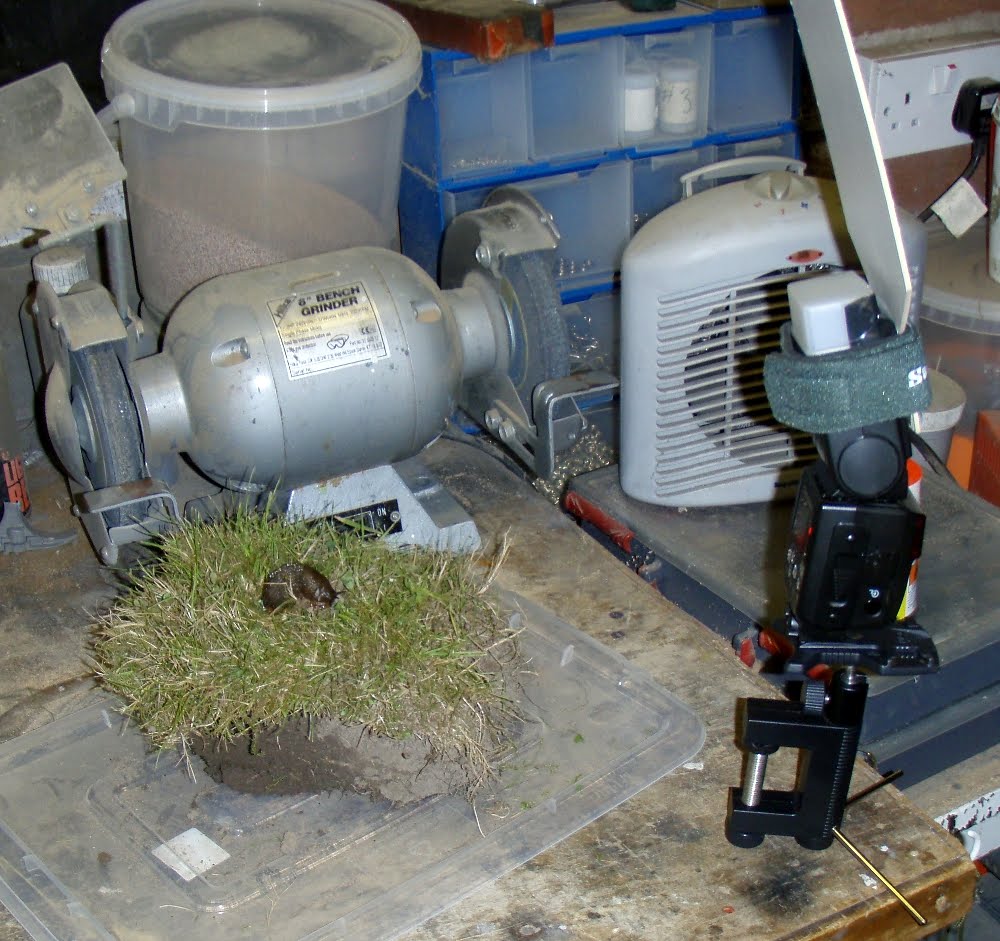
During this outing I mused on how I could photograph slugs and snails. Nocturnally active molluscs that are difficult to focus on with no light. It struck me that as they aren't likely to run away I could take them indoors. In to the garage at least. By the time I had finished my evening meal I'd forgotten all about this. When I was thinking of bed I had a wander round the garden and saw a big brown slug. I got the camera ready, setting it up to use the in-camera flash to trigger the flashgun remotely. I attached the flashgun to a table-tripod I have and added my bounce card to soften the light. The next job was to build the set and add the cast of one.

The stage was easy. One of the turfs cut from the pond would do, which I placed on a plastic lid to keep the soil off my workbench. The slug was plucked from the lawn with a gloved hand and deposited on the sod. All I had to do was wait for it to unfurl and I'd be in business.

Lights. Camera. Action!

What I should have done was clip the grass. The star was reluctant and managed to hide behind the short green blades. A pair of scissors did the trick.

Next time I'll make a better job of things, but it was a fun start. One thing I will do is get a cake-maker's turntable to put the turf on. Ol' Sluggy had a habit of turning away from the lens. Playing around with the lighting will also be done. Either with another flash gun, different diffusion, or some small studio lights.

Speedy the Slug

There's more scope for this table-top studio work. Snails and woodlice come to mind as potential subjects that can be photographed inside on easily made convincing sets.