Monday, 23 February 2015

More books

It doesn't seem like three months since I wrote about Black Country Stories. Although  both Martin Parr and Chris Steele-Perkins are members of Magnum their pictures are very different in style.

A Place in the Country could easily have been a coffee table book look at the life of an English country house. I came across one such book on one of my web surfing trips and despite the pictures being 'nice' the thing seemed to more like a travel brochure. Chris Steele-Perkins avoids this approach, as is to be expected.

The two bodies of work overlap in time, with pictures of Jubillee celebrations appearing in both volumes. While the two books deal with different aspects of British life, and the style of the pictures are different, the feel of them somehow gets across, to me at least, something about Englishness that binds social strata together. I think they make good companions on my bookshelf.

They say that if you are a collector you should focus on one theme and on items you like rather than on ones you think might increase in value. This is why I have missed out on a couple of books which sold out quickly and escalated in value immediately - even though I knew they would. I don't have much of a head for business...

Sticking with my British theme I recently  added a book that's been on my wish list for some time. Jem Southam's The River, Winter. What eventually made be buy the book was watching a lecture he gave in association with On Landscape. I'd read an interview with Southam in a free to view edition some time back, so when the video was available to watch for just a couple of quid I coughed up. It was well worth the money. I really enjoyed listening to him talking about his approach, and the pictures were interesting too. There's a free to watch interview with Jem Southam here, and the full lecture can be found on that site once you have registered.

While not documentary in the same sense as Black Country Stories or A Place in the Country, there is a documentary aspect to the Southam book, but it is essentially a quiet, contemplative work that is almost the opposite of what hobbyist photographers think of as landscape photography. There are no punchy sunsets or wide angle lenses in evidence!

There was a very high tide last week and I took the opportunity to go look at the marsh at the tide's peak. Quite a remarkable sight to see so much water right up to the floodbank. I think I made one frame that sort of sets the scene for the place better than my previous attempts in the same spot with the tide out. I'm not convinced I'll ever be cut out for landscape photography though.


Sunday, 22 February 2015

Slow on the uptake

When I've been to the poultry shows I'd been plagued by variations in white balance. I'd put this down to a combination of light sources in the shed. Yesterday there was another show and early one I noticed some pictures which had two colour casts as bands over the frame (see right). It wasn't until I was sat having a mug of tea that I remembered reading on 'that forum' about the cycling of fluorescent tubes causing such issues. Why hadn't I made the association earlier? D'oh!

Shooting in low light without flash my usual procedure is to set the shutter speed and aperture manually, letting the camera set the ISO. As a rule I use 1/125th of a second as my starting point and vary the aperture as I go along. Occasionally I'll nudge the shutter speed around. For chickens faster is better as they are twitchy creatures.

Unable to recall the shutter speed I needed to select I scrolled through the pics on the back of the camera looking to see which speeds were causing the problem. Anything  at1/125th was affected to varying degrees, anything at 1/00th or lower was fine. Reset the shutter speed and back in the shed. Problem solved.

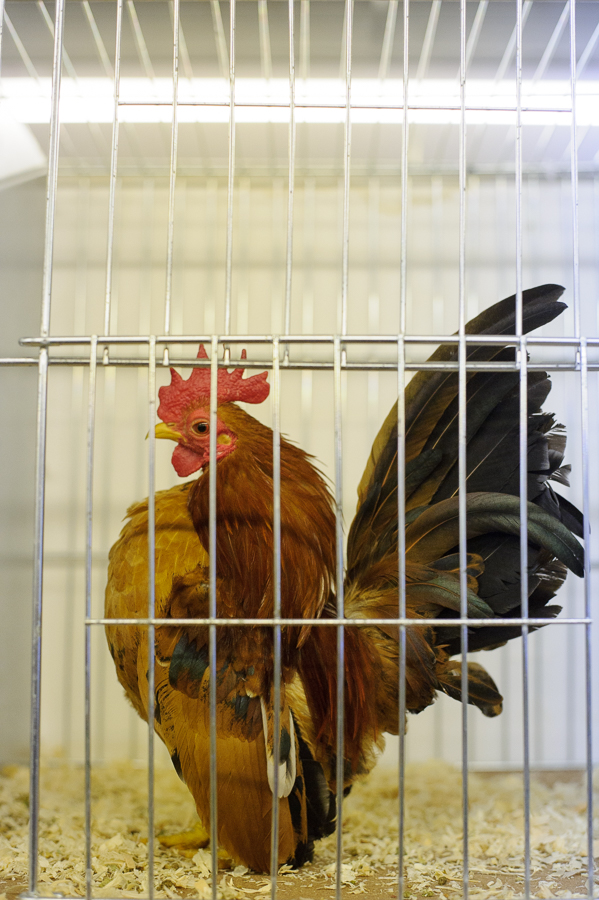
There's a saying that dogs and owners grow to look like each other. I'm not sure if it's the same with chickens, but both the owners and the fowl have character. I wouldn't want to argue with this cockerel!


 It's a funny thing, but when you revisit places or events two contradictory effects are at play with finding pictures. After a while familiarity kicks in and you start to repeat pictures. Not altogether a bad thing as you are constantly looking for better and better versions of the same picture. On the other had the more times you go to an event the greater the chances of something unusual happening. This came together for me with the frame below that combined a bantam with it's head out of the cage (seen before) with a background bird and a unifying yellow theme (birds and rosette) in a reasonably gestural composition.


I tried to make more people pictures than in previous visits. It's a difficult venue because the aisles are narrow and most of the time people are looking at cages. I also managed to bugger up the two potentially best people pics by missing focus through incompetence. This being one. Oh well.


I did 'nail focus' on one I liked. The chicken on the apron is a neat little detail.


With a bit of luck I'll learn from my mistakes. A pity I always learn long after the event...

Gallery.

Tuesday, 17 February 2015

Somebody stop me!

I must stop putting the subject smack bang in the middle of the frame and taking symmetrical photos.


Anyway. I managed to get hold of another (used, naturally) copy of the lens I had to return last week. This one does as it should, and produces pics with then same visual qualities. Note; that's not the same as Image Quality, which is something gearheads take to mean 'sharpness'. Apart from it being small and light I really like the way the out of focus regions decay. Some cheapo lenses give harsh, almost jagged, out of focus areas. This one doesn't. It gives good bokeh.


Damn. That post's in the middle of the frame...

How out of focus areas appear is important. Not for the popular reason of using shallow depth of field for its own sake - which is a mannerism - but so that background detail can be 'read' even though it is out of focus. If it all goes to mush you lose context and are left with a subject floating around in space. Degraded detail maintains the context. Without knowing where something is, how it relates to its surroundings there's no 'story' to the picture.

While most camera nerds test lenses for sharpness with charts pinned to walls and their cameras set up precisely parallel to them on rock-solid tripods, I go out and take hand-held pictures of signs. Signs are good because the lettering and images have sharp edges, and they are sometimes printed on surfaces with fine textures. These two, when pixel-peeped, are as sharp as I need.


I quite like them as pictures too. Which is actually why I shot them. They just happened to provide a test of the lens's sharpness. Somehow I managed to make them unsymmetrical too.

Either I've been dead lucky, I'm not fussy, or a lot of internet-photographers are deluded, but I've yet to buy a Nikon lens which has needed to be adjusted to my camera bodies. I've fiddled with the fine tuning feature a couple of times and seen no difference. Maybe if my camera was always locked down on a tripod with the aperture wide open I'd see the need, but as I either shoot hand-held or with the lens stopped down when the camera is (rarely) on a tripod I either have enough depth of focus to hide imperfections, or they are likely to be messed up by my shaky hands anyway. In fact any focussing issues I have I always blame on poor technique rather than faulty or misaligned gear. More people ought to admit to their inadequacies in this department I reckon.

Looked at 100% on the computer this shot is sharp where it needs to be sharp - on the hook. No fine tuning, hand held, available light, and a lens which has a flake of crap inside it. It's the second frame. The first was well soft thanks to my dodgy technique. Nice bokeh, too...


Odd folk, carp anglers.


Friday, 13 February 2015

Coincidence

There's me mentioning Sugimoto's seascapes last Sunday when The Art of Photography posts a video about them today.


Tuesday, 10 February 2015

I've had enough

Disillusionment is a terrible thing. I'm becoming increasingly intolerant of the nonsense that gets posted on so-called photography forums. I know it's the same on any specialist forum, but you'd think photographers would want to discuss photography. No. It's all gear, pixels and the quest for the ultimate 'image quality'. Good enough just isn't good enough for the majority. As soon as I've used the forum I belong to to sell a couple of lenses I think I'll delete the place from my bookmarks. Although I might drop a bombshell expounding on the benefits of UV filters over lens hoods, of variable aperture 'consumer' zoom lenses, how it's better to buy the latest full frame body for its state of the art sensor and to use it with cheap lenses rather than spend a fortune on 'fast glass', and that digital is too sharp before I go!


One of the biggest moans on the forum from old men like myself is that their DSLR gear is too heavy to carry around all day. Their answer is a smaller camera system but with the equivalent, fast,  expensive lenses in a range to cover every eventuality.

My answer is simple. Cut it down. Get rid of the bag full of 'pro' lenses and the battery grip and shove a consumer zoom on the bloody thing. Better still something like a 28 or 35 fixed focal length lens. You really, really don't need to take lenses to cover every eventuality with you. If you are doing that then I reckon you don't know what you want to photograph or how. Oh, and don't hang the damned camera around your neck, hang it off one shoulder - it will feel lighter even with a heavy lens on it.

Don't get me started on camera straps. Thread after thread moaning about how rubbish the straps are that come with cameras and recommendations for fancy straps that cost a fortune. I fell for that one. Briefly. The only improvement that's needed on a camera strap is to add a swivel between the strap and the camera. I've done that on two cameras and the bane of all straps - getting twisted up - was immediately banished. Oh dear, the split ring rubs on the camera... What you do get is the option to hang the strap over your shoulder grippy side up or down. For swinging the camera into action grippy side up is best. Does away with the need for those 'rapid' straps that hang the camera upside down and make you look like a divvy.

Trying to practice what I preach I now have my lightweight, cheap, fixed focal length lenses sorted out. Not for me the stupidly expensive and needlessly wide apertured choices (I have no desire to go for that super-shallow depth of field look - which demands the sharpest of lenses for some reason), the cheaper not quite so wide-apertured versions do for me. They're sharp enough and I always stop them down. With the amazing high ISO performance of modern cameras in low light there's no need to shoot wide open like I used to do with HP5 in a dimly lit room.

Two of the heavy zooms are likely to go. One definitely has shot its last frame for me. It's 'amateur' replacement is more fun to use and very nearly as sharp. A bit of a problem in low light, but that's what the non-zooms are for. The mid range zoom is on borrowed time, only because the used copy of its replacement I received today was faulty. It worked, but wouldn't zoom out all the way. I could have lived with the missing 5mm but had the feeling the problem was caused by something loose inside the lens - a recipe for future disaster. Still, the few frames I did shoot with the lens (including the canal boats above) convinced me to look for another copy. It's as light as a feather and very compact. Good enough is fine by me. The fast telephoto will be staying. Hanging off a shoulder rather than round my neck I hardly notice it, and there's no cheaper option that would save me money,  weight and bulk. The macro lens will be finding a new home too. I just don't have enough need for it. The close-up work I do can be accomplished quite well enough with the kit lens on my fishing camera, with the addition of  a close-up lens if I need to get closer still. If I was perfectly honest, I could manage with just the 28, 50 and 85 - which almost gets me back where I started in 1980 as I've mentioned before.

It's a funny thing, but what started me on this rationalisation process was being a bit nerdy and checking the EXIF data on some photographs (by a professional photographer) I liked. I was surprised to discover that a lot of them were made with 'consumer' zooms. It shouldn't have been a surprise as somewhere on the web I'd watched footage of David Bailey using just such a lens. The lesson from both these cases being that a wide ranging zoom is just what you need in a situation where you are documenting what is going on in a tricky environment. Bailey was in a helicopter somewhere dusty photographing troops and the other chap was in a lifeboat. Two places where changing lenses wouldn't be a good idea, and even swapping cameras might get dodgy!

For some uses there's always the small sensor option. Kirk Tuck posted about a feature he shot for a magazine using a Sony up-market compact. For my ongoing tackle shop project I think I could manage with my compact set to shoot black and white jpegs if today's trial is anything to go by.


I was pleasantly surprised how decent the files were. They're never going to be used at anything above A3, mostly A4 or smaller. I'll be trying that out again. In any case, a bit of noise/grain never looks out of place in black and white. Today's lesson being to use the most appropriate gear - not the overall technically best.

The yin to Kirk Tuck's yang is some otherwise good pictures shot on medium format digital and processed to look like a twelve year old had produced them. It's not cricket to slag other people's work off, but all the gear and no idea was what sprang to my mind when I saw this lot on the BBC website. Is that really selective colour? Was the saturation slider stuck at max? Whatever you do, do NOT Google the photographer and find his website. Not unless you want your eyes to bleed! It's a shame, because the underlying pictures are okay. It's just those colours remind me of the dying words of Kurtz  in The Heart of Darkness; "The horror! The horror!"

I feel better for getting that lot off my chest.